 Gym Track
5 Day Workout Split for Muscle & Strength
October 24, 2026 · 27 min read
5 Day Workout Split for Muscle & Strength
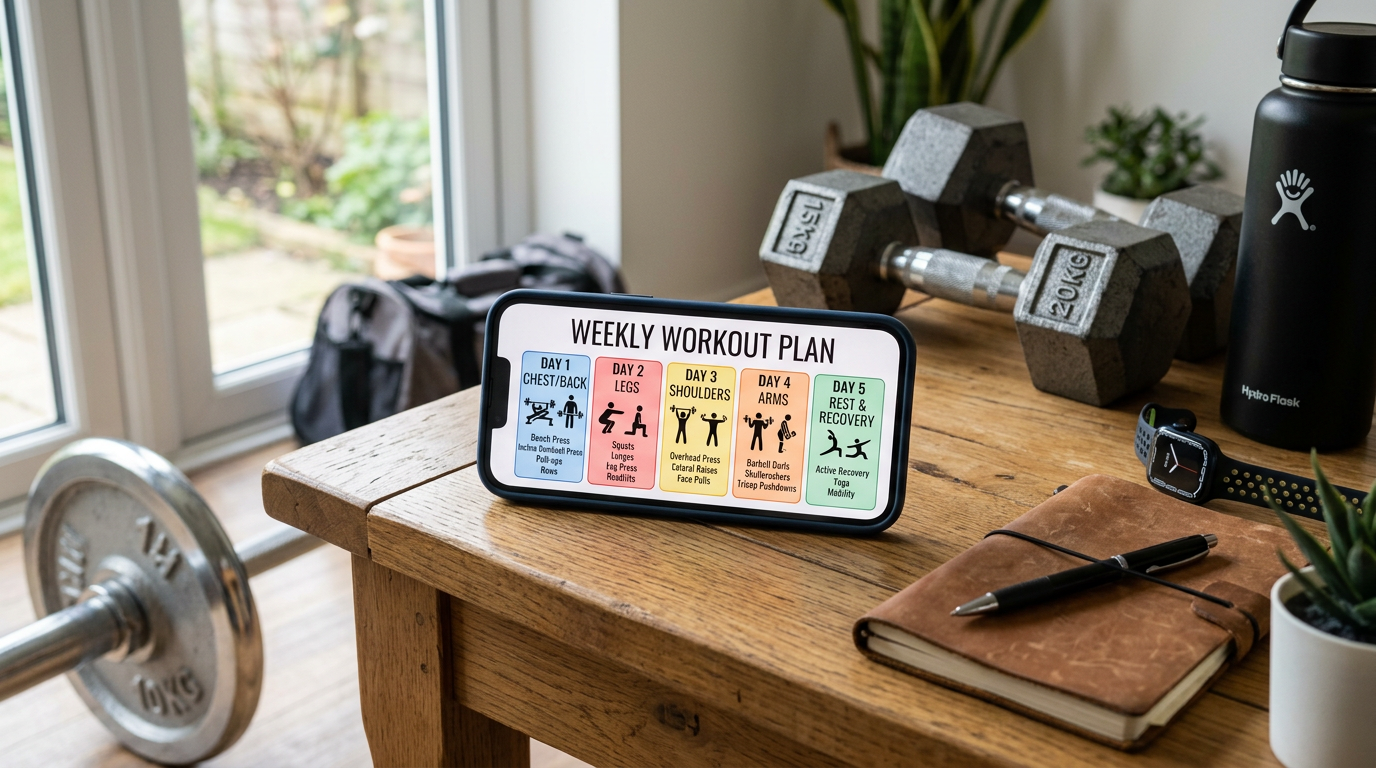
A 5 day workout split divides training across five weekly sessions, typically isolating 1-2 muscle groups per workout. Common approaches include push/pull/legs with two variations, body part splits targeting chest, back, shoulders, legs, and arms, or upper/lower combinations with dedicated accessory days for maximum volume and recovery between muscle groups.
You walk into the gym four days a week. You follow a program. You make progress. Then you plateau.
Adding a fifth training day changes everything. More volume per muscle group. Better recovery between sessions. Specific focus that lets you hammer weak points without compromising compound lifts.
The right workout splits determine whether you spin your wheels or build consistent strength. A 5 day split gives you enough frequency to hit each muscle group hard while maintaining recovery. You can dedicate entire sessions to lagging body parts. You can program heavy compounds without worrying about overlap.
This guide breaks down how to structure a 5 day split for muscle and strength. You will see specific programming options, volume recommendations, and how to track progress using a workout tracking app that handles the complexity of multi-day splits.
Key Takeaways
- 5 day splits allow 48-72 hours recovery between muscle groups while training 5 times weekly
- Push/pull/legs variations and body part splits are most effective for intermediate to advanced lifters
- Each muscle group receives 12-20 sets per week spread across 1-2 dedicated sessions
- Tracking per-set targets and progressive overload becomes critical with higher training frequency
- Rest days should be strategically placed after high-fatigue sessions like legs or deadlifts
What Makes a 5 Day Workout Split Effective
A 5 day split works because it balances training volume with recovery time. You hit each major muscle group with 12-20 sets per week while allowing 48-72 hours between sessions targeting the same muscles. This frequency drives hypertrophy and strength gains without the systemic fatigue of full body training five times weekly.
The math is simple. If you need 15 sets per muscle group weekly and train each group once, that is 15 sets in one brutal session. Split that across two sessions and you maintain intensity while managing fatigue.
Volume Distribution Across Training Days
Five training days let you distribute volume intelligently. A typical week might include:
- Day 1: Chest and triceps with 6-8 exercises
- Day 2: Back and biceps with 6-8 exercises
- Day 3: Legs with 6-7 exercises
- Day 4: Shoulders and abs with 5-6 exercises
- Day 5: Arms and weak points with 6-7 exercises
Each session runs 60-75 minutes. You perform 3-4 sets per exercise. Total weekly volume hits 20-25 sets per major muscle group.
Recovery Between Muscle Groups
The key advantage is recovery time. After destroying your chest on Monday, you do not touch it again until Friday or the following Monday. That gives 4-7 days for muscle protein synthesis and strength adaptation.
Compare this to upper/lower splits where you might hit chest twice in 3-4 days. Or full body programs where overlap is constant. Five day splits eliminate this issue entirely.
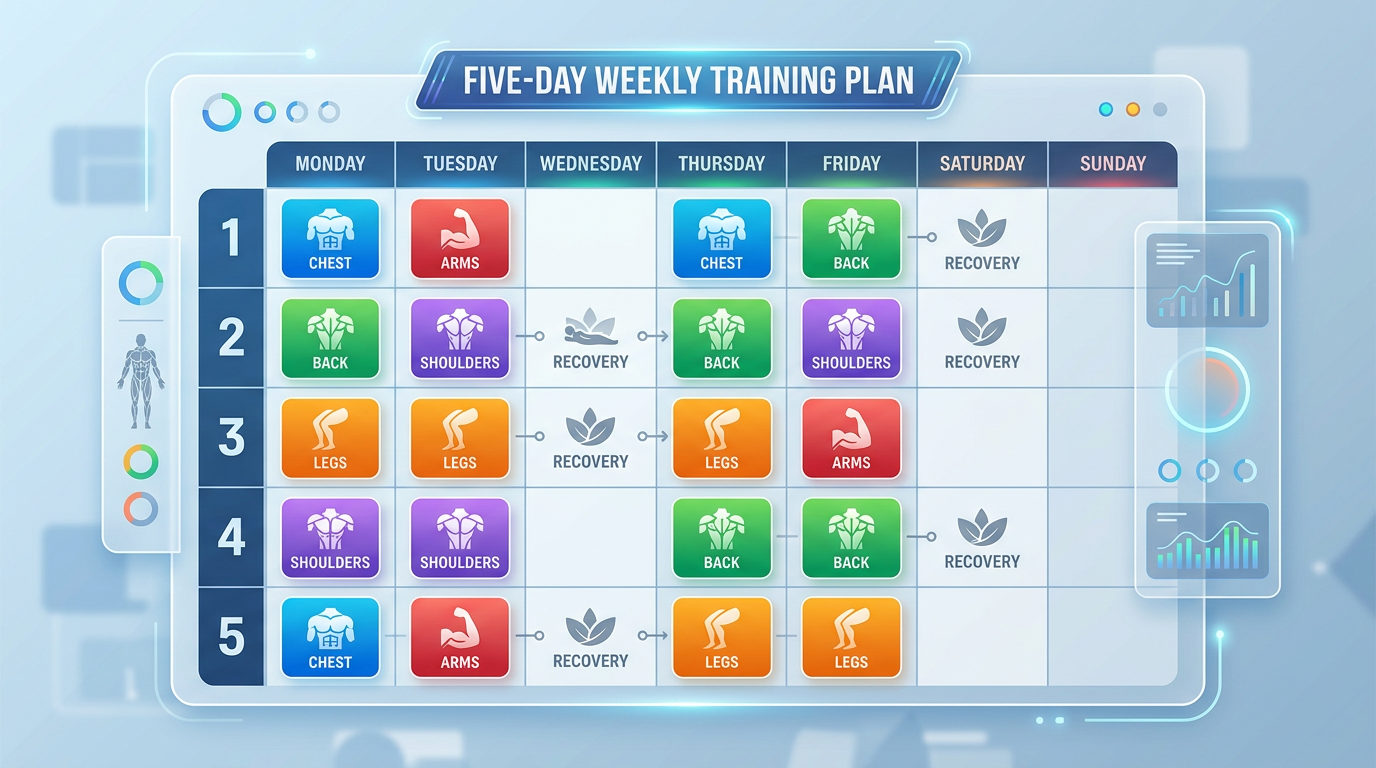
Diagram showing 5 day workout split weekly schedule with muscle groups color-coded and recovery days marked between same muscle group training sessions
Who Should Use a 5 Day Split
This approach works best for intermediate to advanced lifters. You should have at least 12-18 months of consistent training. Your main lifts should be solid. Squat and deadlift form should be automatic.
Beginners waste this split. They do not need the volume. They cannot generate enough intensity per set to justify 15-20 sets per muscle group. A 3 or 4 day program builds more strength with less time investment.
If you can train 5 days weekly without missing sessions, if you have specific physique goals beyond general strength, if you want to bring up lagging body parts, this split delivers.
The Best 5 Day Workout Splits for Different Goals
Not all 5 day splits are created equal. Your goal determines the structure. Building maximum muscle requires different programming than peaking strength or improving weak points.
Push/Pull/Legs with Variations
The push/pull/legs split run twice weekly with one day dropped is the most versatile 5 day option. You train push movements (chest, shoulders, triceps), pull movements (back, biceps), and legs on separate days. Run the cycle 1.5 times per week.
Week 1 structure:
- Monday: Push (heavy chest focus)
- Tuesday: Pull (heavy back focus)
- Wednesday: Legs (squat emphasis)
- Thursday: Rest
- Friday: Push (shoulder and tricep focus)
- Saturday: Pull (volume back work)
- Sunday: Rest
Week 2 continues the rotation. You hit legs again on Monday, then push on Tuesday. This creates a rolling schedule where each muscle group gets trained every 4-5 days.
The advantage is balanced frequency. Every muscle group receives attention twice per week. You can program one heavy session and one volume session for each category.
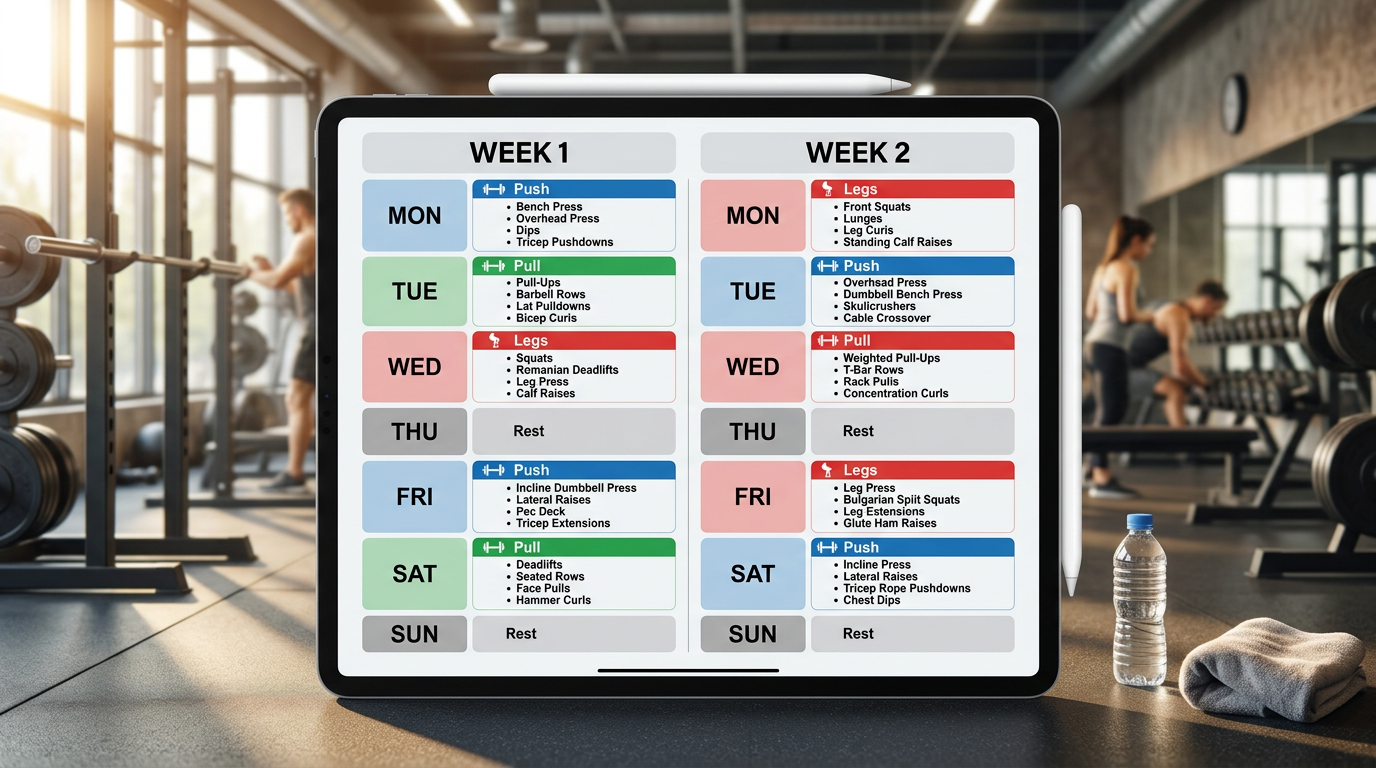
Weekly calendar showing push/pull/legs 5 day split rotation across two weeks with exercise examples listed for each training day
Body Part Split
The classic bodybuilding approach dedicates each day to specific muscle groups:
- Monday: Chest (8-10 exercises, 16-20 sets)
- Tuesday: Back (8-10 exercises, 18-22 sets)
- Wednesday: Rest
- Thursday: Shoulders (6-8 exercises, 12-16 sets)
- Friday: Legs (7-9 exercises, 18-22 sets)
- Saturday: Arms (8-10 exercises, 16-20 sets total)
- Sunday: Rest
This split maximizes volume per session. You can perform 15-20 sets for one muscle group without time constraints. Every set targets the same area, creating massive metabolic stress and muscle damage.
The downside is frequency. Each muscle group trains once weekly. You need to make every session count. Miss a workout and that muscle group goes 10-14 days between training sessions.
Upper/Lower with Specialty Days
A hybrid approach uses upper/lower splits with dedicated weak point days:
- Monday: Upper A (heavy pressing)
- Tuesday: Lower A (squat focus)
- Wednesday: Rest
- Thursday: Upper B (heavy pulling)
- Friday: Lower B (deadlift focus)
- Saturday: Arms and weak points
- Sunday: Rest
This structure gives you four days of compound movement training plus one day for isolation work. Your main lifts get adequate frequency. Your arms and shoulders receive extra volume without compromising recovery.
How to Program Volume and Intensity
Volume and intensity determine results. Too much volume with too much intensity leads to burnout. Too little of either wastes training days.
Weekly Volume Guidelines
Each muscle group needs 12-20 sets per week for hypertrophy, with larger muscles requiring the higher end of that range. A 5 day split distributes this volume across 1-2 sessions per muscle group.
Recommended weekly sets by muscle group:
- Chest: 12-18 sets (bench press variations, flies, dips)
- Back: 16-22 sets (rows, pulldowns, deadlift variations)
- Quads: 12-16 sets (squats, leg press, lunges)
- Hamstrings: 8-12 sets (RDLs, leg curls, good mornings)
- Shoulders: 12-16 sets (press variations, raises)
- Arms: 12-16 sets total (6-8 sets biceps, 6-8 sets triceps)
Track your sets weekly using a workout tracking app. Gym Track automatically counts sets per muscle group and warns you when volume exceeds recovery capacity.
Intensity Distribution
Not every set should be taken to failure. Intensity must vary across the week to manage fatigue.
Use this framework:
- Heavy compound lifts: RPE 7-9 (1-3 reps in reserve)
- Secondary compounds: RPE 6-8 (2-4 reps in reserve)
- Isolation exercises: RPE 7-9 (1-3 reps in reserve, occasionally to failure)
- Last set of isolation work: RPE 9-10 (0-1 reps in reserve)
Heavy squats and deadlifts should rarely exceed RPE 8-9. These movements create systemic fatigue that affects subsequent training days. Save true max effort for peak weeks or testing days.
Isolation work tolerates higher intensity. Taking cable flies or leg extensions to failure does not compromise your next workout. Use these movements to accumulate volume near failure without excessive fatigue.
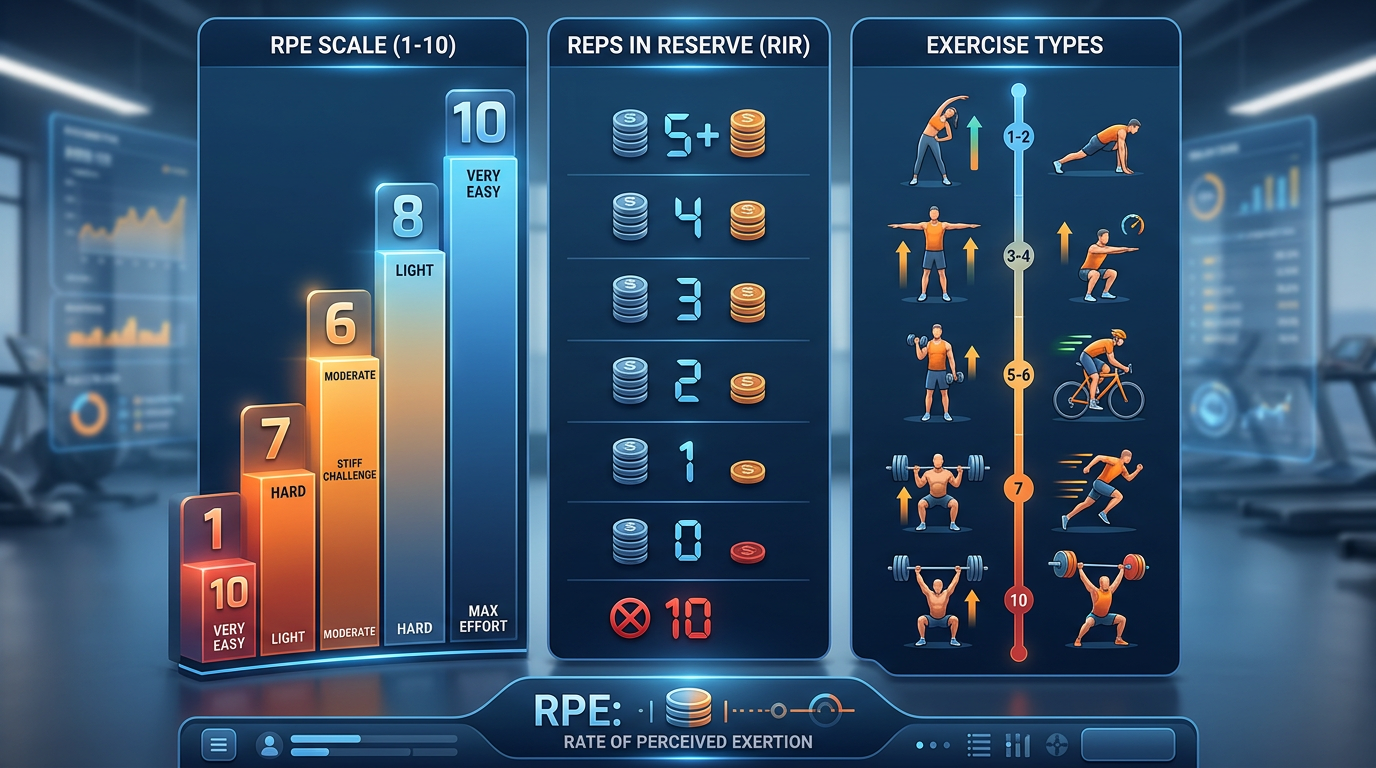
Chart showing RPE scale from 1-10 with corresponding reps in reserve and recommended exercise types for each intensity level
Progressive Overload Strategies
You need clear progression metrics. Adding weight is not the only option on a 5 day split.
Progression methods ranked by effectiveness:
- Add 2.5-5 lbs to compound lifts when you hit top end of rep range across all sets
- Add 1 rep per set until you reach top of range, then increase weight
- Add 1 set per muscle group every 2-3 weeks until you hit volume ceiling
- Reduce rest periods by 15-30 seconds while maintaining reps and weight
- Increase range of motion or time under tension on isolation exercises
A good workout tracker handles this automatically. Gym Track compares your current session to previous weeks and suggests weight increases when you exceed programmed reps. It tracks projected 1RM across all your main lifts so you see strength gains even when working in higher rep ranges.
Sample 5 Day Split Programs
Here are three complete programs you can run immediately. Each includes specific exercises, sets, reps, and rest periods.
Program 1: Hypertrophy Focus
This program maximizes muscle growth through high volume and moderate intensity.
Day 1: Chest and Triceps
- Barbell Bench Press: 4 sets x 6-8 reps, 3 min rest
- Incline Dumbbell Press: 3 sets x 8-10 reps, 2 min rest
- Cable Fly: 3 sets x 12-15 reps, 90 sec rest
- Close Grip Bench Press: 3 sets x 8-10 reps, 2 min rest
- Overhead Tricep Extension: 3 sets x 12-15 reps, 90 sec rest
- Tricep Pushdown: 3 sets x 15-20 reps, 60 sec rest
Day 2: Back and Biceps
- Deadlift: 4 sets x 5-6 reps, 3 min rest
- Barbell Row: 4 sets x 8-10 reps, 2 min rest
- Lat Pulldown: 3 sets x 10-12 reps, 90 sec rest
- Cable Row: 3 sets x 12-15 reps, 90 sec rest
- Barbell Curl: 3 sets x 8-10 reps, 2 min rest
- Hammer Curl: 3 sets x 12-15 reps, 90 sec rest
Day 3: Legs
- Back Squat: 4 sets x 6-8 reps, 3 min rest
- Romanian Deadlift: 3 sets x 8-10 reps, 2 min rest
- Leg Press: 3 sets x 12-15 reps, 2 min rest
- Walking Lunges: 3 sets x 10 reps per leg, 90 sec rest
- Leg Curl: 3 sets x 12-15 reps, 90 sec rest
- Calf Raise: 4 sets x 15-20 reps, 60 sec rest
Day 4: Shoulders and Abs
- Overhead Press: 4 sets x 6-8 reps, 3 min rest
- Lateral Raise: 4 sets x 12-15 reps, 90 sec rest
- Rear Delt Fly: 4 sets x 15-20 reps, 60 sec rest
- Face Pull: 3 sets x 15-20 reps, 60 sec rest
- Hanging Leg Raise: 3 sets x 10-15 reps, 90 sec rest
- Cable Crunch: 3 sets x 15-20 reps, 60 sec rest
Day 5: Arms and Weak Points
- Incline Dumbbell Curl: 3 sets x 10-12 reps, 90 sec rest
- Preacher Curl: 3 sets x 12-15 reps, 90 sec rest
- Cable Curl: 2 sets x 15-20 reps, 60 sec rest
- Skull Crusher: 3 sets x 10-12 reps, 90 sec rest
- Dips: 3 sets x 8-12 reps, 2 min rest
- Cable Pushdown: 2 sets x 15-20 reps, 60 sec rest
- Weak point work: 3-4 sets of lagging muscle group
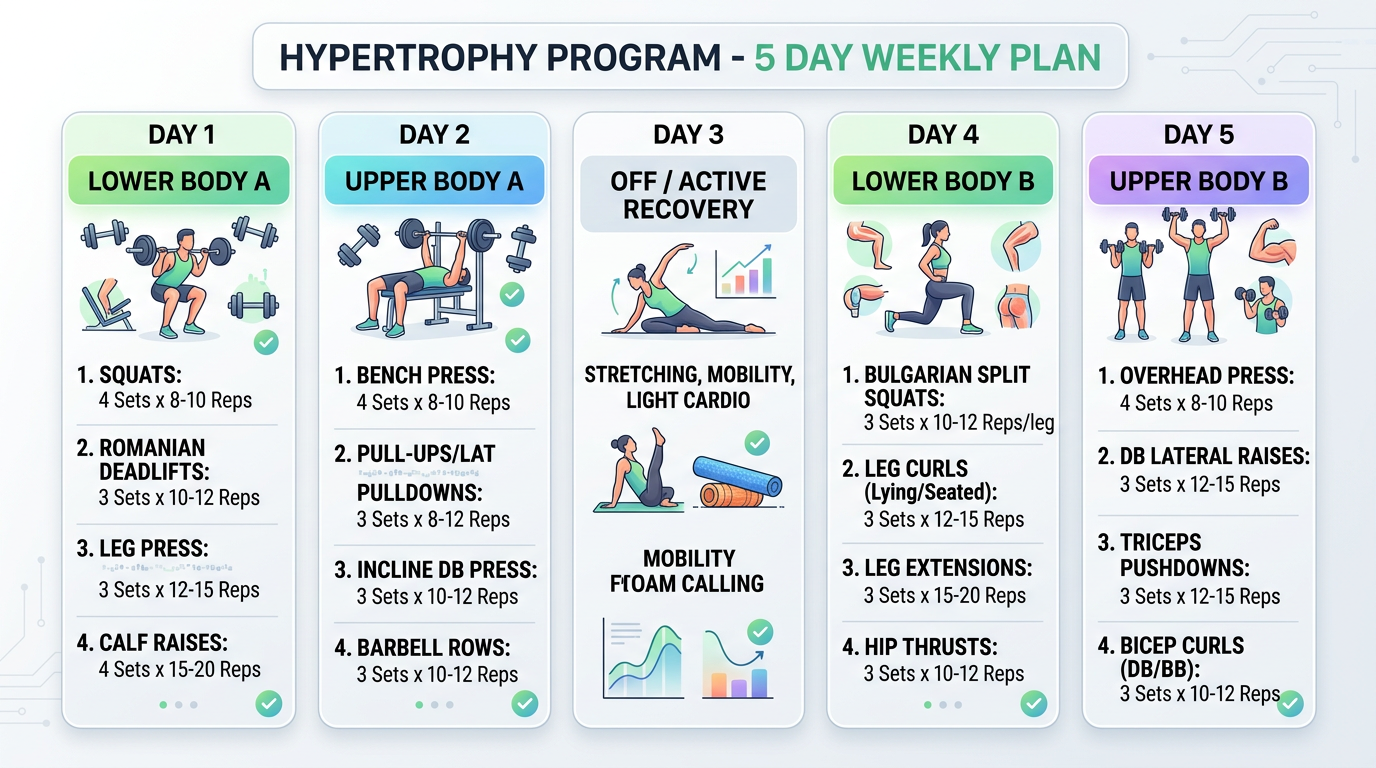
Infographic showing all 5 training days of the hypertrophy program with exercise names, sets, and reps in a clean weekly calendar format
Program 2: Strength and Size
This program balances heavy compound work with hypertrophy accessories.
Day 1: Heavy Push
- Barbell Bench Press: 5 sets x 3-5 reps, 3-4 min rest
- Overhead Press: 4 sets x 5-6 reps, 3 min rest
- Incline Bench Press: 3 sets x 8-10 reps, 2 min rest
- Dips: 3 sets x 8-12 reps, 2 min rest
- Lateral Raise: 3 sets x 15-20 reps, 60 sec rest
Day 2: Heavy Pull
- Deadlift: 5 sets x 3-5 reps, 3-4 min rest
- Barbell Row: 4 sets x 5-6 reps, 3 min rest
- Weighted Pull-up: 4 sets x 6-8 reps, 2-3 min rest
- Cable Row: 3 sets x 10-12 reps, 90 sec rest
- Face Pull: 3 sets x 15-20 reps, 60 sec rest
Day 3: Heavy Legs
- Back Squat: 5 sets x 3-5 reps, 3-4 min rest
- Front Squat: 3 sets x 6-8 reps, 3 min rest
- Romanian Deadlift: 3 sets x 8-10 reps, 2 min rest
- Leg Press: 3 sets x 12-15 reps, 2 min rest
- Leg Curl: 3 sets x 12-15 reps, 90 sec rest
Day 4: Volume Push
- Incline Dumbbell Press: 4 sets x 8-10 reps, 2 min rest
- Dumbbell Shoulder Press: 3 sets x 10-12 reps, 2 min rest
- Cable Fly: 3 sets x 12-15 reps, 90 sec rest
- Lateral Raise: 4 sets x 12-15 reps, 60 sec rest
- Tricep Pushdown: 3 sets x 15-20 reps, 60 sec rest
- Overhead Extension: 3 sets x 12-15 reps, 90 sec rest
Day 5: Volume Pull and Arms
- Lat Pulldown: 4 sets x 10-12 reps, 90 sec rest
- T-Bar Row: 3 sets x 10-12 reps, 2 min rest
- Dumbbell Row: 3 sets x 12-15 reps, 90 sec rest
- Barbell Curl: 3 sets x 8-10 reps, 2 min rest
- Hammer Curl: 3 sets x 10-12 reps, 90 sec rest
- Preacher Curl: 2 sets x 12-15 reps, 90 sec rest
Program 3: Push/Pull/Legs Rotation
This program runs PPL 1.5 times weekly for balanced frequency.
Day 1: Push A
- Barbell Bench Press: 4 sets x 6-8 reps
- Overhead Press: 3 sets x 8-10 reps
- Incline Dumbbell Press: 3 sets x 10-12 reps
- Lateral Raise: 3 sets x 12-15 reps
- Tricep Pushdown: 3 sets x 12-15 reps
- Overhead Extension: 2 sets x 15-20 reps
Day 2: Pull A
- Deadlift: 4 sets x 5-6 reps
- Weighted Pull-up: 3 sets x 6-8 reps
- Barbell Row: 3 sets x 8-10 reps
- Face Pull: 3 sets x 15-20 reps
- Barbell Curl: 3 sets x 8-10 reps
- Hammer Curl: 2 sets x 12-15 reps
Day 3: Legs A
- Back Squat: 4 sets x 6-8 reps
- Romanian Deadlift: 3 sets x 8-10 reps
- Leg Press: 3 sets x 12-15 reps
- Leg Curl: 3 sets x 12-15 reps
- Calf Raise: 4 sets x 15-20 reps
Day 4: Push B
- Incline Barbell Press: 4 sets x 6-8 reps
- Dumbbell Shoulder Press: 3 sets x 8-10 reps
- Cable Fly: 3 sets x 12-15 reps
- Rear Delt Fly: 3 sets x 15-20 reps
- Close Grip Bench: 3 sets x 8-10 reps
- Tricep Pushdown: 2 sets x 15-20 reps
Day 5: Pull B
- Lat Pulldown: 4 sets x 8-10 reps
- T-Bar Row: 3 sets x 10-12 reps
- Cable Row: 3 sets x 12-15 reps
- Shrug: 3 sets x 12-15 reps
- Incline Curl: 3 sets x 10-12 reps
- Cable Curl: 2 sets x 15-20 reps
Tracking Progress on a 5 Day Split
Five training days generate massive amounts of data. You cannot track this in your head. You need a system.
What to Track Per Workout
Log every set with weight, reps, and RPE to identify progression opportunities and prevent overtraining. This data reveals patterns you miss otherwise.
Essential metrics per session:
- Exercise name
- Weight used per set
- Reps completed per set
- RPE or RIR for compound lifts
- Rest periods for main exercises
- Total session duration
- Subjective energy and performance notes
Gym Track logs all this in under 10 seconds per set. Tap the exercise, enter weight and reps, swipe for RPE. The app automatically calculates volume load, tracks PRs, and updates projected 1RMs.
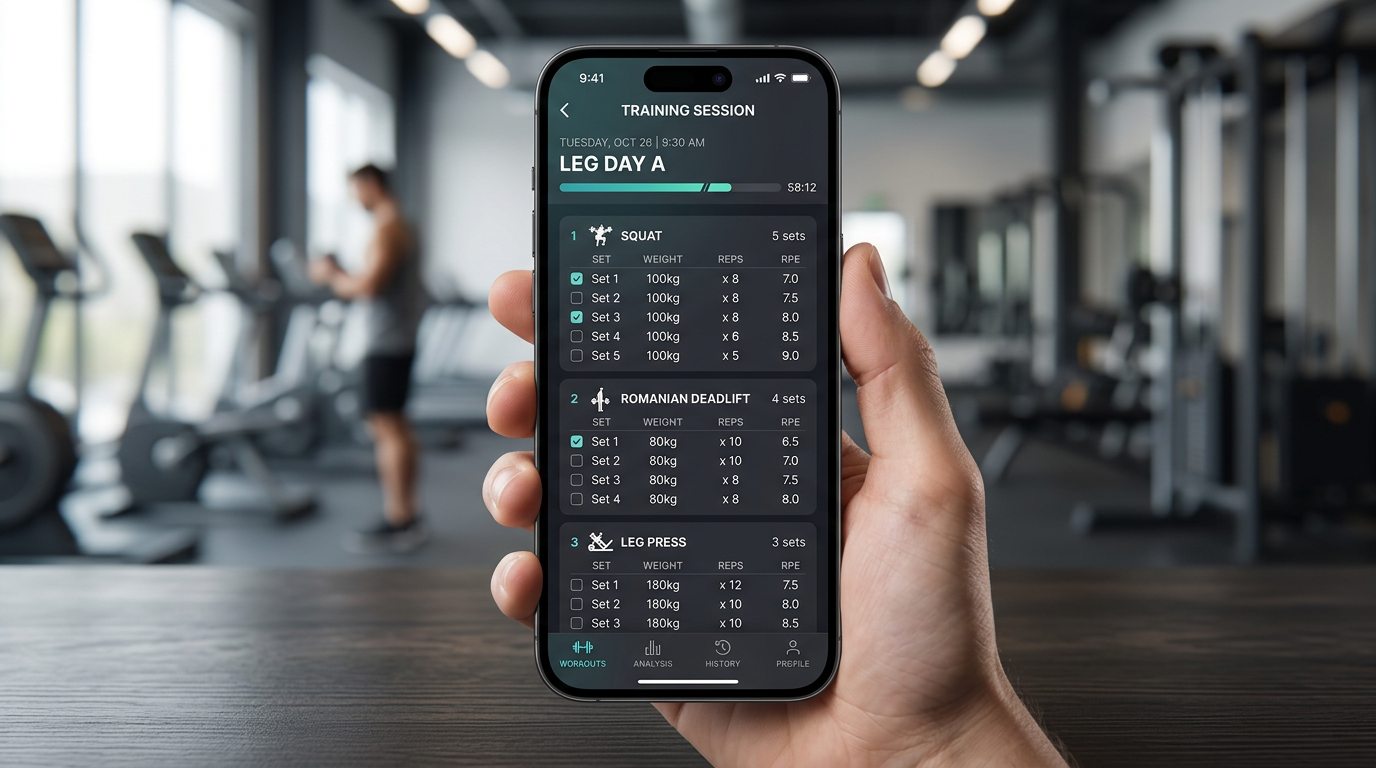
Screenshot of workout tracking app interface showing a logged training session with sets, reps, weight, and RPE clearly displayed for multiple exercises
Weekly and Monthly Metrics
Zoom out to see trends. Weekly volume per muscle group matters more than individual sessions.
Track these metrics weekly:
- Total sets per muscle group
- Average intensity (RPE) across compound lifts
- Volume load (sets x reps x weight) for main movements
- Missed sessions or deload indicators
Monthly tracking reveals long-term progress:
- Projected 1RM increases on squat, bench, deadlift, overhead press
- Rep PRs at specific weights
- Body weight and measurements
- Average weekly volume trends
Good workout tracking apps surface this automatically. Gym Track shows volume trends by muscle group, highlights PRs as you log them, and charts strength progression over months. Hevy offers similar features with a simpler interface. Strong focuses on basic logging with excellent historical data views.
When to Adjust Your Program
Data tells you when to change variables. Look for these signals:
Increase volume when strength gains stall for 2-3 weeks despite adequate recovery. Add 2-3 sets per muscle group weekly.
Decrease volume when average RPE exceeds 8.5 across all sessions for two consecutive weeks. Cut 20 percent of total sets and maintain for one week.
Adjust exercise selection when a movement causes pain or feels awkward after multiple form corrections. Swap for a similar pattern with different loading.
Take a deload week when projected 1RMs decrease by 5 percent or more, sleep quality drops, or motivation tanks. Cut volume by 40-50 percent and intensity by 10-15 percent for one week.
Common Mistakes with 5 Day Splits
Most people fail 5 day splits through poor planning, not lack of effort.
Too Much Volume Too Soon
Jumping from 3-4 training days to 5 days with maximum volume per session destroys recovery. Your body needs time to adapt to increased frequency.
Start with minimum effective volume. Use the low end of set recommendations for each muscle group. Add 1-2 sets per muscle group every 2-3 weeks. Let your body tell you when it can handle more.
If you were doing 12 sets per muscle group on a 4 day split, start with 12-14 sets on the 5 day split. Not 18-20 sets immediately.
Ignoring Recovery Factors
Five hard training sessions require deliberate recovery. Sleep, nutrition, and stress management become non-negotiable.
You need 7-9 hours of sleep nightly. Less than this and you will not recover between sessions. Your nervous system cannot handle high frequency training on 6 hours of sleep.
Protein intake should hit 0.8-1 gram per pound of body weight daily. Spread this across 4-5 meals. Post-workout protein matters less than total daily intake.
Manage life stress. High work stress plus relationship stress plus 5 hard training days equals burnout. Be honest about your stress capacity and adjust training accordingly.
Poor Exercise Selection
Not every exercise belongs in a 5 day split. Some movements create too much fatigue for the benefit they provide.
Limit heavy deadlift variations to once weekly. Doing heavy conventional deadlifts twice per week on a 5 day split compromises squat performance and lower back recovery.
Use machine and cable exercises for high-rep work. These movements let you accumulate volume without technique breakdown. Barbell movements should focus on the 5-10 rep range where form stays tight.
Avoid redundant exercises. You do not need barbell rows, dumbbell rows, cable rows, and t-bar rows in the same session. Pick 2-3 rowing variations and execute them well.
Inconsistent Scheduling
Training Monday, Tuesday, Wednesday, then taking four days off ruins the split. The frequency advantage disappears when rest days cluster together.
Spread training days across the week. Common patterns include Monday/Tuesday/Thursday/Friday/Saturday or Monday/Tuesday/Wednesday/Friday/Saturday.
Place rest days strategically. Put a rest day after your hardest session (usually legs). Put another rest day before your next high-fatigue workout. This maintains performance across all five training days.
How 5 Day Splits Compare to Other Workout Splits
Different splits serve different goals and schedules. Here is how a 5 day split stacks up.
5 Day Split vs 3 Day Full Body
A 3 day full body split trains each muscle group three times weekly with lower volume per session. You might do 4-6 sets per muscle group each workout for 12-18 total weekly sets.
Full body splits work better for beginners and intermediate lifters focused on strength. The higher frequency improves motor learning on compound lifts. Session duration stays under 60 minutes. You can miss one workout without losing weekly frequency.
Five day splits win for muscle growth and bringing up weak points. The volume per session lets you exhaust a muscle group completely. You can dedicate 45-60 minutes to just chest and triceps. This depth of work is impossible on full body days.
Choose 3 day full body if you want general strength and fitness with minimal time investment. Choose 5 day splits if you want maximum muscle growth and have specific physique goals.
5 Day Split vs 4 Day Upper/Lower
A 4 day upper/lower split trains upper body twice weekly and lower body twice weekly. Each muscle group receives 8-12 sets per session for 16-24 total weekly sets.
Upper/lower splits balance frequency and volume well. You hit each muscle group twice per week with adequate volume. Sessions run 60-75 minutes. The structure is simple to follow and hard to mess up.
The advantage of 5 day splits is specialization. You can dedicate entire sessions to arms, shoulders, or other smaller muscle groups. Upper/lower splits force you to combine muscle groups, limiting volume for smaller areas.
Upper/lower splits suit lifters who want balanced development without excessive time in the gym. Five day splits suit lifters who enjoy training and want to maximize specific muscle groups.
Bro Split vs Modern 5 Day Approaches
The traditional bro split trains one muscle group per day: chest Monday, back Tuesday, shoulders Wednesday, legs Thursday, arms Friday. Each muscle group trains once weekly with very high volume per session.
This approach fell out of favor because once-weekly frequency is suboptimal for most lifters. Muscle protein synthesis peaks 24-48 hours post-training and returns to baseline by 72 hours. Training a muscle once every 7 days misses opportunities for growth.
Modern 5 day splits improve on this by increasing frequency. Push/pull/legs rotations hit each muscle group every 4-5 days. Upper/lower with specialty days trains major muscle groups twice weekly. These approaches maintain high volume while improving frequency.
The bro split still works if you can generate enormous intensity per session and recover fully between weekly sessions. Most lifters see better results with higher frequency approaches.
Nutrition and Recovery for 5 Day Training
Training 5 days weekly demands more from your body than 3-4 day programs. Nutrition and recovery become limiting factors.
Calorie and Protein Requirements
Consume 250-500 calories above maintenance when building muscle on a 5 day split, with protein at 0.8-1 gram per pound of body weight daily. This surplus supports recovery and muscle growth without excessive fat gain.
Calculate maintenance calories using your body weight, activity level, and tracking data. Add 300-400 calories for muscle gain. Weigh yourself weekly and adjust based on rate of gain. Target 0.5-1 pound per week for most lifters.
Protein timing matters less than total intake. Spread protein across 4-5 meals daily. Each meal should contain 25-40 grams of protein. This maintains elevated muscle protein synthesis throughout the day.
Pre and post-workout nutrition is overrated. Total daily protein and calories determine results. If you train fasted or do not eat immediately post-workout, you will still build muscle if daily targets are met.
Sleep and Rest Days
Sleep is when you grow. Five hard training sessions create significant recovery debt that only sleep can repay.
Target 7-9 hours nightly. Track sleep duration and quality. Notice how performance changes with different amounts of sleep. Most lifters perform best with 8 hours consistently.
Use rest days actively. Light cardio, stretching, or mobility work keeps you moving without creating fatigue. Complete rest is fine too. Listen to your body.
Consider naps on high-volume days. A 20-30 minute nap post-workout aids recovery. Longer naps may interfere with nighttime sleep.
Supplements Worth Considering
Most supplements are worthless. These few have solid evidence:
- Creatine monohydrate: 5 grams daily improves strength and power output
- Caffeine: 3-6 mg per kg body weight pre-workout enhances performance
- Whey protein: Convenient protein source when whole foods are impractical
- Vitamin D: 2000-4000 IU daily if you have limited sun exposure
Everything else is optional. Pre-workouts are just caffeine with filler. BCAAs are unnecessary if protein intake is adequate. Testosterone boosters do not work.
Spend money on food and a good workout tracker before buying supplements.
Using Apps to Run 5 Day Splits
Paper logs cannot handle the complexity of 5 day splits. You need digital tracking to manage volume, intensity, and progression across multiple sessions weekly.
Features That Matter for Split Training
The right app makes logging effortless and surfaces insights you would miss manually.
Essential features for 5 day splits:
- Fast set logging with weight, reps, and RPE in under 10 seconds
- Automatic PR detection across all rep ranges
- Volume tracking per muscle group weekly
- Projected 1RM calculations that update in real-time
- Program templates or the ability to build custom splits
- Rest timer that starts automatically between sets
- Historical data comparison to see progress over months
Gym Track offers all of these with per-set targets that guide you through workouts. You see exactly what weight and reps to hit based on your program. The app detects PRs automatically and updates your projected maxes after every set.
Comparing Popular Workout Trackers
Several apps handle 5 day splits well. Each has strengths.
Gym Track excels at fast logging and AI coaching. The interface is built for lifters who want to log sets quickly and move on. The AI coach analyzes your training history and suggests adjustments. Best for serious lifters following structured programs who want automatic progression tracking.
Hevy offers excellent social features and a large exercise library. The interface is clean and intuitive. Volume tracking is solid. Best for lifters who want a polished app with community features and do not need advanced programming tools.
Strong focuses on simplicity and historical data. The app has been around for years with a loyal user base. Logging is straightforward. Charts show long-term trends clearly. Best for lifters who want reliable basic tracking without extra features.
Boostcamp provides free access to popular programs from well-known coaches. You follow pre-built programs with daily workouts laid out. Best for lifters who want to run established programs without building their own splits.
Choose based on your priorities. If you want fast logging with per-set guidance and AI coaching, use Gym Track. If you want social features and a polished interface, try Hevy. If you want simplicity and longevity, use Strong. If you want to follow established programs, try Boostcamp.
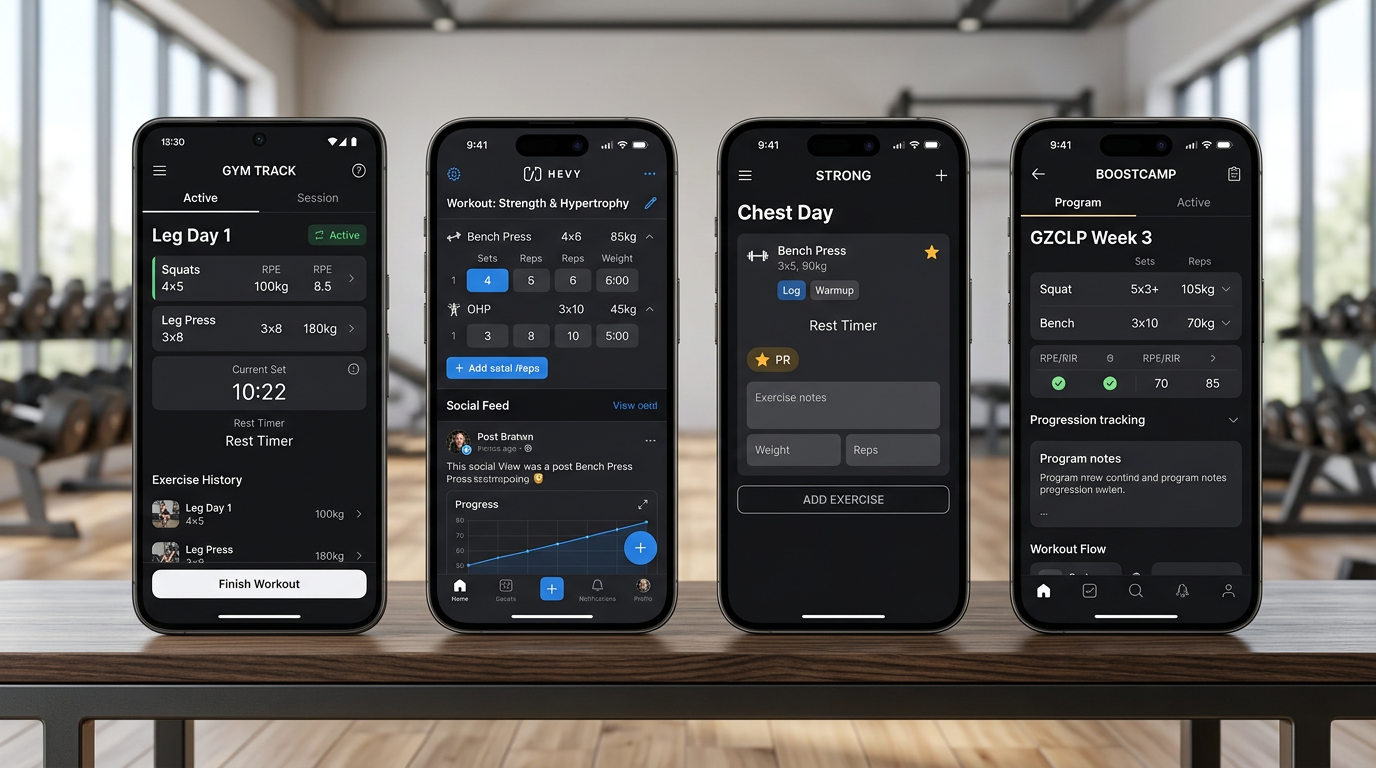
Side-by-side comparison screenshots of Gym Track, Hevy, Strong, and Boostcamp apps showing their workout logging interfaces
Setting Up Your Split in an App
Most apps let you build custom programs or choose from templates.
To set up a 5 day split:
- Create a new program or routine
- Name each training day (Push A, Pull A, Legs, etc)
- Add exercises to each day with target sets and reps
- Set rest periods for compound lifts (2-3 minutes) and isolation work (60-90 seconds)
- Schedule training days across the week
- Enable automatic progression if available
Gym Track simplifies this with per-set targets. You enter your program once with specific weight and rep targets for each set. The app guides you through workouts and suggests when to increase weight based on performance.
Update your program every 4-6 weeks. Change exercises, adjust rep ranges, or modify volume based on progress and recovery.
Frequently Asked Questions
What is a good 3-day full body workout plan for building muscle and strength?
A good 3-day full body plan includes squat or leg press, bench or overhead press, and a rowing movement each session. Perform 3-4 sets of 6-10 reps on compounds with 2-3 accessory exercises per muscle group. Train Monday, Wednesday, Friday with 48 hours between sessions for recovery.
What is the 3-2-1 rule for working out?
The 3-2-1 rule suggests three strength sessions, two cardio sessions, and one flexibility or mobility session weekly. This framework balances resistance training, cardiovascular health, and recovery work. Most lifters following structured programs can ignore this rule and focus on their specific training split instead.
Can you provide a 4-day upper/lower split workout routine?
A 4-day upper/lower split trains upper body Monday and Thursday, lower body Tuesday and Friday. Upper days include bench press, rows, overhead press, and arm work for 16-20 sets total. Lower days include squats, deadlift variations, and leg accessories for 16-20 sets. Rest Wednesday and weekends.
What is the difference between bro split and upper/lower body training?
Bro splits train one muscle group per day with once-weekly frequency and high volume per session. Upper/lower splits train all upper body muscles twice weekly and all lower body muscles twice weekly with moderate volume per session. Upper/lower provides better frequency for most lifters.
How long should each workout be on a 5 day split?
Each workout on a 5 day split should last 60-75 minutes including warm-up. This allows 6-8 exercises with 3-4 sets each and adequate rest between sets. Sessions longer than 90 minutes indicate too much volume or excessive rest periods that should be reduced.
Should I do cardio on a 5 day lifting split?
Add 2-3 cardio sessions of 20-30 minutes on rest days or after lifting if your goal includes fat loss or cardiovascular health. Keep intensity moderate to avoid interfering with recovery. Lifters focused solely on muscle and strength can minimize cardio to preserve recovery capacity.
Can beginners use a 5 day workout split?
Beginners should start with 3-4 day full body or upper/lower splits to build work capacity and learn movement patterns. After 12-18 months of consistent training, transition to 5 day splits when you need more volume per muscle group and have established solid technique on main lifts.
Conclusion
A 5 day workout split delivers maximum muscle growth and strength gains for intermediate to advanced lifters who can commit to consistent training. The structure allows high volume per muscle group while maintaining adequate recovery between sessions. Choose push/pull/legs rotations for balanced frequency, body part splits for maximum volume, or upper/lower hybrids for strength focus.
Track every set with weight, reps, and RPE using a workout tracker that handles the complexity of five training days. Gym Track provides per-set targets, automatic PR detection, and AI coaching based on your training history. Start with minimum effective volume and add sets gradually as your work capacity improves.
The best workout splits match your schedule, recovery capacity, and specific goals. A well-programmed 5 day split with consistent execution beats any other approach for serious lifters focused on physique development.
Log your next session in Gym Track
Fast set logging, automatic PRs, programs with per-set targets and an AI coach that reads your history. Free on iPhone and Android.
Get the app