 Gym Track
5/3/1 Program Explained: Why Lifters Swear By It
October 27, 2026 · 24 min read

5/3/1 Program Explained: Why Lifters Swear By It
The 5/3/1 program explained is a percentage-based strength training system built around four main lifts: squat, bench press, deadlift, and overhead press. Each cycle uses three weeks of progressive loading at 65-95% of your training max, followed by a deload week, with prescribed rep schemes of 5, 3, and 1 plus AMRAP sets to drive strength gains.
You walk into the gym with a plan. You know exactly what weight goes on the bar. You hit your prescribed reps, maybe push an AMRAP set, and you leave. No guesswork. No program hopping. Just consistent progress over months and years.
That is why lifters stick with the 5/3/1 program explained by Jim Wendler. It strips away complexity and gives you a framework that works whether you are chasing a 500 pound deadlift or just want to get stronger without overthinking your training. The program has been around since 2009 and remains one of the most recommended intermediate strength programs because it delivers results through simple progression and built-in autoregulation.
This guide breaks down how 5/3/1 works, why it is effective, and how to track it properly using a workout app designed for lifters who follow structured programs. You will learn the exact percentages, rep schemes, progression model, and common variations so you can decide if this program fits your training goals.
Key Takeaways
- 5/3/1 uses three-week cycles with prescribed percentages based on 90% of your true 1RM, called your training max
- Each main lift follows a 5s week (65-85%), 3s week (70-90%), and 1s week (75-95%) before a deload
- The last set of each workout is an AMRAP set that provides autoregulation and drives hypertrophy
- Assistance work follows templates like Boring But Big, First Set Last, or Building the Monolith
- Progress is added in small increments every cycle: 5 pounds for lower body, 2.5-5 pounds for upper body
What Is the 5/3/1 Program Explained
The 5/3/1 program is a four-day-per-week strength training system where each session focuses on one main barbell lift using percentage-based loading. Jim Wendler created it after years as an elite powerlifter, designing a program that builds strength without the burnout of constant maximal effort training.
The name comes from the rep scheme: Week 1 uses sets of 5 reps, Week 2 uses sets of 3 reps, and Week 3 uses sets of 5, 3, then 1 rep. Each week increases intensity while decreasing volume. After three weeks, you take a deload week at reduced percentages, then start a new cycle with slightly heavier weights.
Unlike linear programs where you add weight every session, 5/3/1 progresses monthly. This slower progression suits intermediate lifters who can no longer add weight to the bar every workout. The program uses a training max set at 90% of your true 1RM, which keeps you from grinding reps and allows for consistent quality sets.
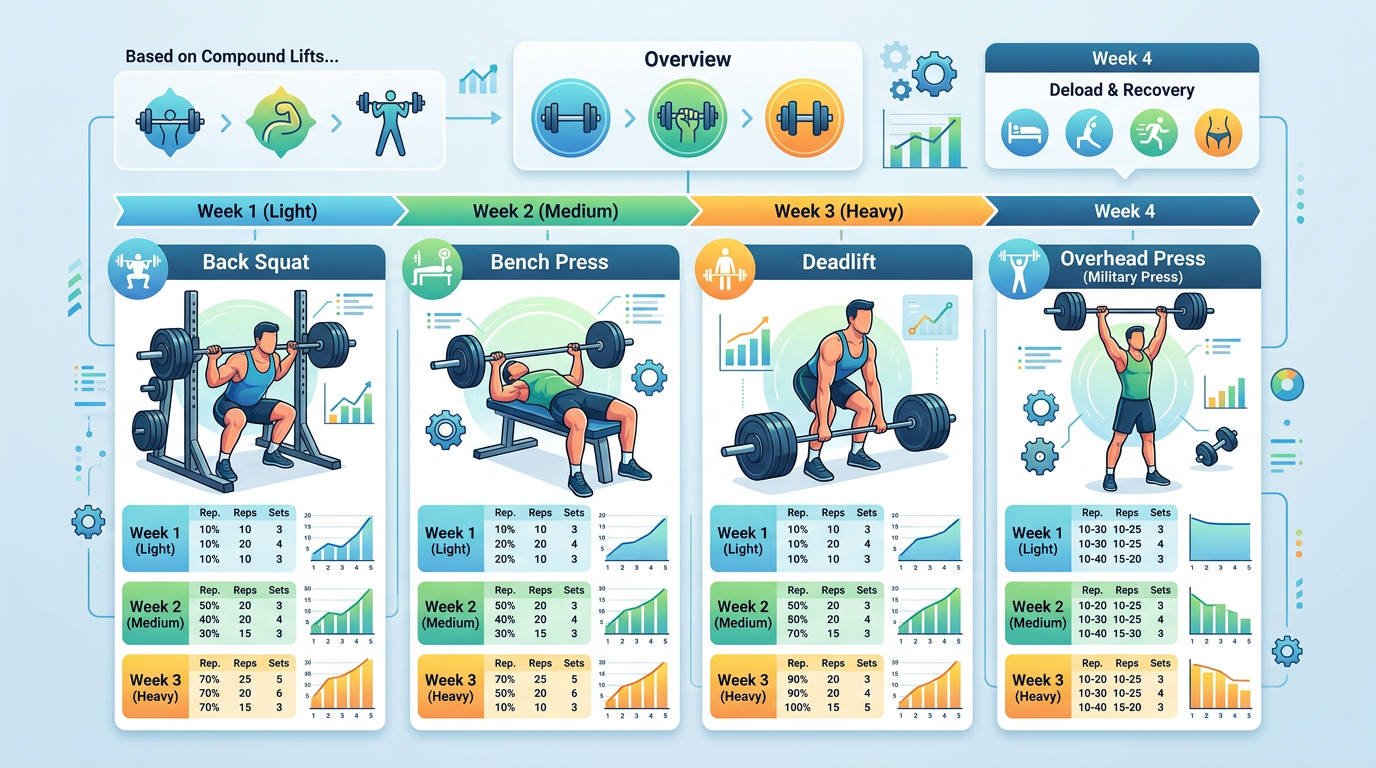
Infographic showing the 5/3/1 program structure with four main lifts (squat, bench press, deadlift, overhead press) arranged in a weekly schedule, displaying the three-week cycle progression and deload week
The Four Main Lifts
Every 5/3/1 program centers on these four compound movements:
- Squat: Usually back squat, though front squat variations exist
- Bench Press: Standard barbell bench, the primary upper body pressing movement
- Deadlift: Conventional or sumo, depending on your preference and leverages
- Overhead Press: Standing barbell press, sometimes called military press or strict press
These lifts are trained once per week each. You do not bench twice or squat twice in the same week. This frequency works for intermediate lifters who need more recovery time between heavy sessions on the same movement pattern.
Training Max vs True Max
Your training max is the foundation of all 5/3/1 calculations. Take 90% of your current 1RM for each lift and use that number to calculate all your working percentages. If your true max squat is 400 pounds, your training max is 360 pounds. All percentages come from 360, not 400.
This built-in buffer prevents you from grinding reps and missing lifts. It keeps bar speed high and technique clean. When the program calls for 95% of your training max, you are actually working at 85.5% of your true max, which is heavy but manageable for quality reps.
How the 5/3/1 Program Works
Each workout follows the same structure: warm-up sets, three main working sets with increasing percentages, and assistance work. The magic happens in how the percentages progress across the three-week cycle.
Week 1: 5s Week
The first week uses moderate weights to build volume:
- Set 1: 65% x 5 reps
- Set 2: 75% x 5 reps
- Set 3: 85% x 5+ reps (AMRAP set)
That third set is your AMRAP (as many reps as possible). You do at least 5 reps but push for more. If you hit 10 reps, your training max is probably too light. If you barely get 5, it might be too heavy. Most lifters hit 7-9 reps on this set when their training max is dialed in correctly.
Week 2: 3s Week
Intensity increases, volume drops:
- Set 1: 70% x 3 reps
- Set 2: 80% x 3 reps
- Set 3: 90% x 3+ reps (AMRAP set)
The AMRAP set at 90% of your training max typically yields 5-7 reps. This is where you build real strength. The weight is heavy enough to challenge you but light enough that you maintain good form and bar speed.
Week 3: 1s Week
Peak intensity week with the heaviest weights of the cycle:
- Set 1: 75% x 5 reps
- Set 2: 85% x 3 reps
- Set 3: 95% x 1+ reps (AMRAP set)
Despite the name, you should get more than 1 rep on that final set. Most lifters hit 3-5 reps at 95% of their training max, which is 85.5% of their true max. This set tests your strength without the nervous system fatigue of a true 1RM attempt.
Week 4: Deload
Recovery week using lighter percentages:
- Set 1: 40% x 5 reps
- Set 2: 50% x 5 reps
- Set 3: 60% x 5 reps
No AMRAP sets during deload. Just hit the prescribed reps and move on. This week lets your body recover while maintaining movement patterns. Many lifters want to skip deloads, but they are essential for long-term progress and injury prevention.
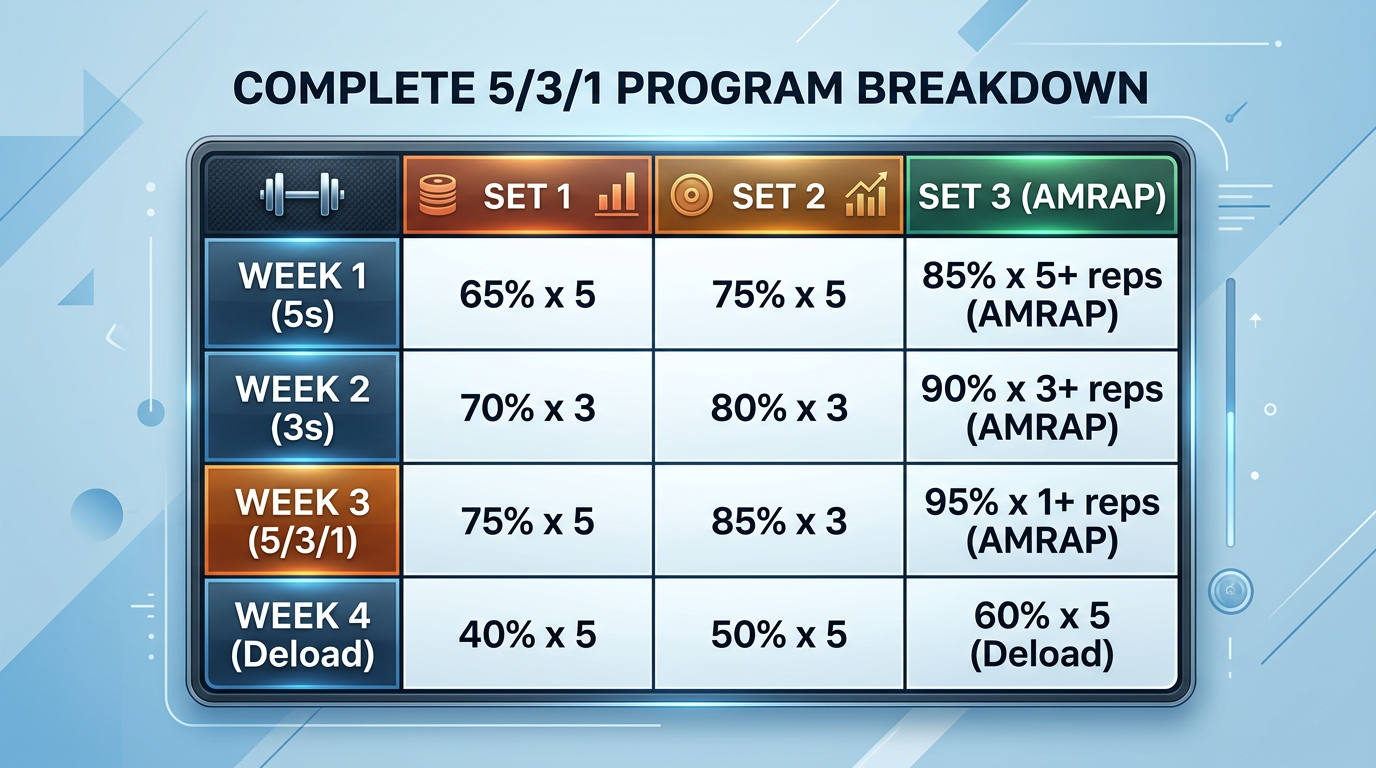
Table showing the complete 5/3/1 percentage breakdown for all four weeks, with columns for Set 1, Set 2, and Set 3, displaying percentages and rep ranges including AMRAP notation
Why the 5/3/1 Program Works for Intermediate Lifters
Beginners can add weight every session because their nervous system adapts quickly and technique improvements drive progress. Intermediate lifters need a different approach. You have exhausted easy neural gains and now progress comes from accumulated volume and strategic intensity.
Built-In Autoregulation
The AMRAP sets provide autoregulation without complicated RPE tracking. On good days you hit more reps, on rough days you hit fewer, but you always complete the minimum prescribed reps. This flexibility prevents you from grinding failed reps while still pushing intensity when you feel strong.
If you hit 12 reps on a set prescribed for 5+, you know to increase your training max more aggressively next cycle. If you barely scrape 5 reps, you maintain or slightly reduce your training max. The program adjusts to your actual strength level through your performance on these sets.
Sustainable Progression
After each four-week cycle, you add weight to your training max:
- Lower body lifts (squat, deadlift): Add 5-10 pounds
- Upper body lifts (bench, overhead press): Add 2.5-5 pounds
This adds up to 60-120 pounds per year on lower body lifts and 30-60 pounds on upper body lifts if you run the program consistently. That progression is realistic for intermediate lifters and sustainable for years without stalling or needing frequent resets.
Volume Without Burnout
Each main lift gets one heavy session per week. This frequency allows full recovery between sessions while providing enough stimulus to drive adaptation. You are not constantly testing maxes or grinding heavy triples. Most of your work sits in the 65-90% range, which builds strength and muscle without excessive fatigue.
The assistance work adds volume in less fatiguing rep ranges. Templates like Boring But Big have you doing 5 sets of 10 reps at 50-60% after your main work. This volume drives hypertrophy and reinforces movement patterns without interfering with recovery for the next heavy session.
Common 5/3/1 Variations and Templates
Jim Wendler has published numerous 5/3/1 variations over the years. Each tweaks the assistance work, frequency, or intensity to target different goals. Here are the most popular templates lifters use.
5/3/1 Boring But Big (BBB)
The most popular variation for building size alongside strength. After your main 5/3/1 work, you do 5 sets of 10 reps at 50-60% of your training max on the same lift. For example, after your heavy squat work, you do 5x10 squats at a lighter weight.
This adds significant volume. Those 50 reps at moderate weight drive hypertrophy while reinforcing technique. The percentage starts at 50% and can progress to 60% or even 70% as you adapt. BBB is ideal if you want to gain muscle mass while getting stronger.
5/3/1 First Set Last (FSL)
After your main sets, you return to the weight from your first working set and do 5 sets of 5 reps. If your first set was 65% for 5 reps, you do 5x5 at 65% after completing all three main sets.
FSL provides less volume than BBB but higher quality reps at a more moderate weight. This works well if you recover slowly or want to focus on bar speed and technique rather than pure volume.
5/3/1 Building the Monolith
A six-week program designed for mass gain. It combines 5/3/1 main work with extremely high assistance volume: 100-200 reps of push, pull, and single-leg or core work per session. You also eat aggressively, with Wendler recommending a dozen eggs and 1.5 pounds of ground beef daily.
This template is brutal. It works if you can eat and sleep enough to recover. Most lifters gain 10-15 pounds over six weeks, with significant strength increases on all main lifts.
5/3/1 for Beginners
Despite the name, this is not for true beginners. It is for lifters transitioning from linear progression to intermediate programming. You train three days per week, doing two main lifts per session: squat and bench on day one, deadlift and overhead press on day two, then squat and bench again on day three.
Each lift is trained twice per week, once heavy and once light. This increased frequency helps you maintain technique and provides more practice with the movements before dropping to once-per-week frequency on standard 5/3/1.
5/3/1 Full Body
You train three days per week with all four lifts spread across the week. One lift is your main focus each day, while the others are done at lighter weights for technique work or assistance. This provides higher frequency than standard 5/3/1 while keeping volume per session manageable.
Assistance Work and Exercise Selection
The main 5/3/1 work takes 15-20 minutes. Assistance work fills the rest of your session and targets weak points, adds volume, and builds muscle. Wendler categorizes assistance into three groups: push, pull, and single-leg or core.
Push Assistance
Exercises that involve pressing or pushing movements:
- Dips (weighted or bodyweight)
- Dumbbell bench press or incline press
- Overhead dumbbell press
- Push-ups (various angles and tempos)
- Tricep extensions or close-grip pressing
On squat and deadlift days, push work targets upper body. On bench and overhead press days, it adds volume to the pressing muscles you just worked.
Pull Assistance
Exercises involving pulling or rowing movements:
- Pull-ups or chin-ups (weighted or bodyweight)
- Barbell rows or dumbbell rows
- Face pulls for rear delts and upper back
- Lat pulldowns in various grips
- Shrugs for trap development
Wendler recommends 50-100 reps of pulling work every training session to balance all the pressing volume and maintain shoulder health. This high pull volume prevents imbalances and builds a thick upper back that supports heavy squats and deadlifts.
Single-Leg and Core
Exercises that target legs unilaterally or core stability:
- Bulgarian split squats or lunges
- Leg press or leg curls
- Ab wheel rollouts
- Hanging leg raises
- Planks and side planks
- Sled pushes or prowler work
Single-leg work addresses imbalances and adds volume without excessive spinal loading. Core work builds the stability needed for heavy squats and deadlifts while improving bracing mechanics.
Tracking Your 5/3/1 Progress
The 5/3/1 program requires precise tracking. You need to know your training max for each lift, calculate percentages for every set, log your AMRAP performance, and plan progression across multiple cycles. A notebook works, but a workout tracking app designed for structured programs makes this significantly easier.
What to Track Each Session
For every workout, you need to record:
- Weight used for each set: Calculated from your current training max
- Reps completed: Especially critical for AMRAP sets
- Projected 1RM from AMRAP sets: Shows if your training max needs adjustment
- Assistance work: Exercises, sets, reps, and weights
- How the session felt: Bar speed, energy levels, any technique issues
Apps like Gym Track handle percentage calculations automatically. You enter your training max once, and the app generates all working weights for the entire cycle. After you log your AMRAP set, it calculates your projected 1RM and flags when you should increase your training max.
When to Increase Your Training Max
The standard recommendation is to add 5-10 pounds to lower body training maxes and 2.5-5 pounds to upper body training maxes after each four-week cycle. But your AMRAP performance tells you if this progression is appropriate.
If you consistently hit high reps on AMRAP sets (10+ on the 5s week, 7+ on the 3s week, 5+ on the 1s week), you can increase more aggressively. If you barely hit the minimum reps, hold your training max steady or increase by the minimum amount. If you miss the minimum reps, reduce your training max by 5-10%.
Using Apps for 5/3/1
Several workout tracking apps support 5/3/1 programming. Strong and Hevy let you manually input the percentages and track your lifts. Boostcamp offers pre-built 5/3/1 templates you can follow. These apps work fine for basic tracking.
Gym Track is built for lifters who follow structured programs like 5/3/1. It calculates all percentages from your training max, provides per-set targets so you know exactly what weight to use, detects PRs automatically when you exceed previous AMRAP performance, and includes an AI coach that reads your training history to suggest when to adjust your training max or modify assistance work. For lifters running 5/3/1 long-term, having these features built into the logging process saves time and prevents calculation errors.
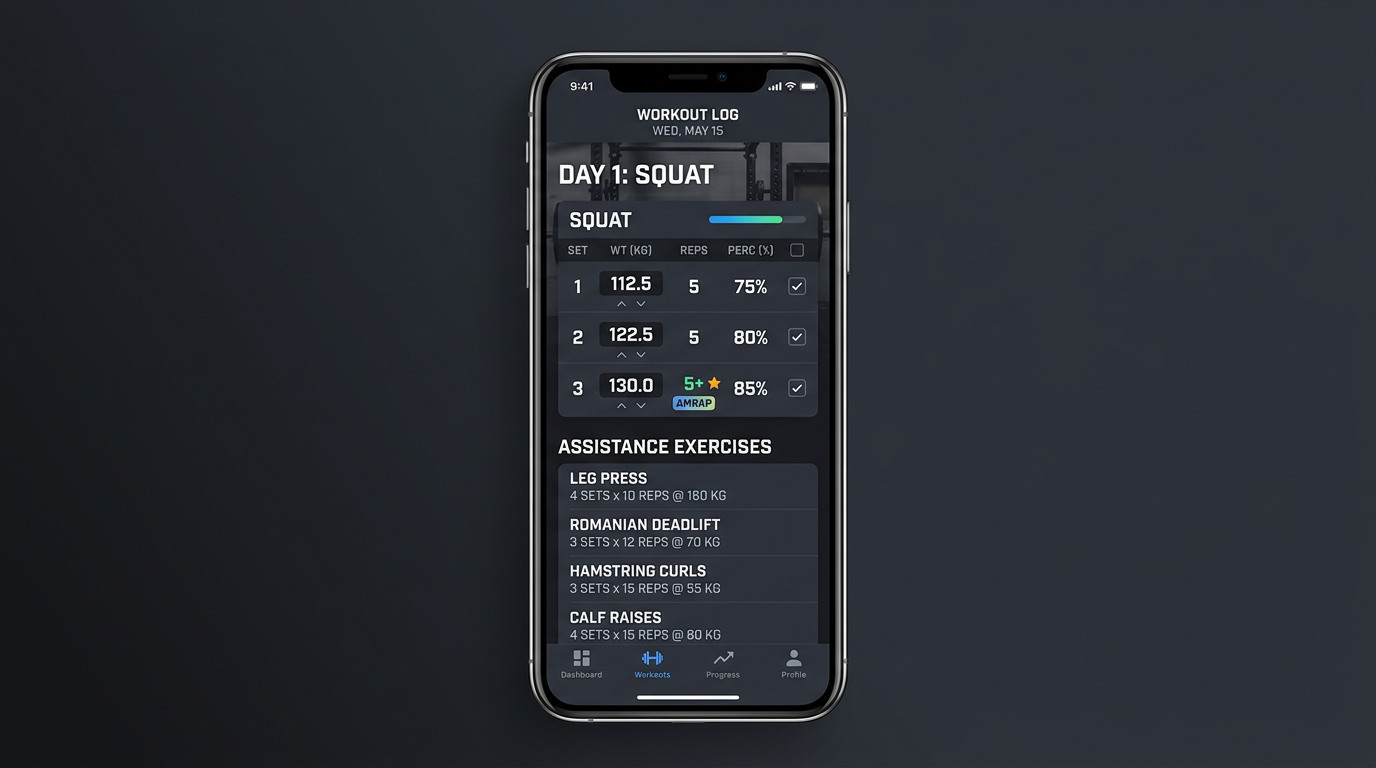
Screenshot mockup of a workout tracking app displaying a 5/3/1 workout for squat day, showing the three main working sets with percentages, target weights, and an AMRAP set indicator, plus assistance exercises listed below
Common Mistakes Running 5/3/1
Lifters make predictable errors when starting 5/3/1. Avoiding these mistakes keeps you progressing steadily instead of stalling or getting injured.
Setting Training Max Too High
The biggest mistake is using your true 1RM instead of 90% of it. This makes every AMRAP set a grinder and prevents you from accumulating quality volume. If you barely hit the minimum reps on AMRAP sets, your training max is too high. Swallow your ego and reduce it by 10%. You will progress faster with a conservative training max than constantly grinding reps.
Skipping Deload Weeks
Deloads feel easy. You want to push harder. But skipping them accumulates fatigue and leads to stalls or injury. The deload week is not optional. It is part of the program design. Use it to recover, work on technique with light weights, and prepare for the next cycle.
Adding Too Much Assistance Work
Some lifters treat assistance work like a bodybuilding session, doing 10 exercises for 4 sets each. This interferes with recovery for the next main lift session. Wendler recommends 50-100 reps each of push, pull, and single-leg or core work. That is 3-4 assistance exercises total, not 10. Keep it simple and focus on quality over quantity.
Changing the Main Lifts
The program is built around back squat, bench press, deadlift, and overhead press. Substituting front squats, incline bench, or other variations changes the program. If you have an injury that prevents one of the main lifts, address the injury or choose a different program. Do not try to modify 5/3/1 into something it is not.
Increasing Training Max Too Aggressively
Adding 10 pounds to your squat training max every cycle sounds great until you stall after three cycles. The program works because progression is slow and sustainable. If you add too much weight too fast, you will hit a wall and need to reset. Trust the process and take the small increases. They compound over time.
Who Should Run 5/3/1
The 5/3/1 program works best for specific lifters at specific training stages. Understanding if it fits your situation helps you decide whether to commit to it.
Ideal for Intermediate Lifters
You have been training consistently for 1-3 years. You can no longer add weight to the bar every session. Your squat is approaching 1.5x bodyweight, deadlift is near 2x bodyweight, and bench press is around bodyweight. You need a program that progresses monthly instead of weekly.
5/3/1 provides the structure and progression model that works at this stage. The monthly increases match your rate of adaptation. The AMRAP sets let you push intensity when you feel strong while the percentage-based main sets keep you from overreaching.
Good for Lifters Who Want Simplicity
If you want to walk into the gym knowing exactly what to do without decisions or guesswork, 5/3/1 delivers. The percentages are set. The rep schemes are prescribed. You just execute the program. This simplicity reduces decision fatigue and lets you focus on effort and technique.
Works for Strength and Size Goals
The main 5/3/1 work builds strength through progressive overload. The AMRAP sets add volume for hypertrophy. Assistance templates like Boring But Big add even more volume for muscle growth. You can run 5/3/1 whether your goal is a bigger total or a bigger physique.
Not Ideal for Advanced Lifters
Once you reach advanced strength levels (2x bodyweight squat, 2.5x deadlift, 1.5x bench, 1x overhead press), you may need more specific programming. Advanced lifters often benefit from higher frequency, more variation, or periodization models that peak for competition. 5/3/1 can still work, but you might outgrow it.
Not for Complete Beginners
If you have been lifting for less than six months, run a linear progression program like Starting Strength or StrongLifts. You can still add weight every session at this stage. Save 5/3/1 for when linear progression stops working. Starting with 5/3/1 as a beginner leaves gains on the table.
Sample 5/3/1 Week Layout
Here is what a typical training week looks like running standard 5/3/1 with Boring But Big assistance. This is Week 1 (5s week) for a lifter with a 315 pound squat training max, 225 pound bench training max, 365 pound deadlift training max, and 135 pound overhead press training max.
Monday: Squat Day
- Warm-up: Bar x 10, 135 x 5, 185 x 5, 225 x 3
- Main Work: 205 x 5 (65%), 235 x 5 (75%), 270 x 5+ (85%)
- BBB: 160 x 10, 5 sets (50%)
- Assistance: Leg curls 3x12, Ab wheel 3x10
Wednesday: Bench Press Day
- Warm-up: Bar x 10, 95 x 5, 135 x 5, 165 x 3
- Main Work: 145 x 5 (65%), 170 x 5 (75%), 190 x 5+ (85%)
- BBB: 115 x 10, 5 sets (50%)
- Assistance: Barbell rows 5x10, Face pulls 3x15
Friday: Deadlift Day
- Warm-up: 135 x 5, 185 x 5, 225 x 5, 275 x 3
- Main Work: 235 x 5 (65%), 275 x 5 (75%), 310 x 5+ (85%)
- BBB: 185 x 10, 5 sets (50%)
- Assistance: Bulgarian split squats 3x8, Hanging leg raises 3x10
Sunday: Overhead Press Day
- Warm-up: Bar x 10, 65 x 5, 85 x 5, 105 x 3
- Main Work: 90 x 5 (65%), 100 x 5 (75%), 115 x 5+ (85%)
- BBB: 70 x 10, 5 sets (50%)
- Assistance: Pull-ups 5x8, Dips 3x10
Each session takes 60-75 minutes including warm-up, main work, assistance, and rest periods. The main work is done in 15-20 minutes. Most of the time is spent on BBB sets and assistance work.
Frequently Asked Questions
How long should I run the 5/3/1 program?
Run 5/3/1 for at least three to six cycles (12-24 weeks) to see meaningful strength gains. Many lifters run it for years with different assistance templates to prevent stagnation. Switch programs only when progress stalls for multiple cycles despite proper training max adjustments.
Can I do 5/3/1 three times per week instead of four?
Yes, run 5/3/1 for Beginners which trains three days per week with two main lifts per session. You alternate between squat with bench press and deadlift with overhead press, training each lift twice weekly at different intensities for increased frequency.
What if I miss the minimum reps on an AMRAP set?
Reduce your training max by 10% and restart the cycle. Missing minimum reps means your training max is too high or you need a deload. Do not push through with incorrect percentages as this leads to poor technique and stalled progress.
Should I do cardio while running 5/3/1?
Wendler recommends conditioning work 2-4 times weekly, including sled pushes, prowler work, hill sprints, or bike intervals. Keep cardio sessions short and intense rather than long steady-state work to avoid interfering with strength recovery and adaptation.
Can I substitute exercises in the 5/3/1 program?
The four main lifts should not be substituted unless injury prevents you from performing them safely. Assistance exercises can be swapped freely as long as you maintain the push, pull, and single-leg or core categories with appropriate volume.
How do I know which 5/3/1 template to choose?
Choose Boring But Big for muscle gain, First Set Last for technique focus with moderate volume, or Building the Monolith for aggressive size and strength gains. Start with standard 5/3/1 or BBB if unsure, then experiment with templates after several cycles.
What is a good AMRAP rep count for each week?
Target 8-10 reps on the 5s week at 85%, 5-7 reps on the 3s week at 90%, and 3-5 reps on the 1s week at 95%. Hitting these ranges indicates your training max is set correctly and allows sustainable progression.
Getting Started with the 5/3/1 Program Explained
The 5/3/1 program works because it removes complexity and focuses on consistent execution over months and years. You do not need perfect genetics or elite recovery. You need accurate training maxes, disciplined progression, and the patience to let small increases compound into significant strength gains.
Calculate your training maxes at 90% of your current 1RM for squat, bench press, deadlift, and overhead press. Choose an assistance template that matches your goals. Track every workout with attention to AMRAP performance since those sets determine your progression. Run at least three cycles before evaluating whether the 5/3/1 program explained here fits your training needs.
Use a workout tracking app that handles percentage calculations and flags when to adjust training maxes based on your logged performance, so you can focus on lifting instead of spreadsheet management.
Log your next session in Gym Track
Fast set logging, automatic PRs, programs with per-set targets and an AI coach that reads your history. Free on iPhone and Android.
Get the app