 Gym Track
5 Best 3 Day Workout Split (2026)
October 25, 2026 · 21 min read

5 Best 3 Day Workout Split (2026)
A 3 day workout split divides weekly training into three sessions targeting different muscle groups or movement patterns. The most effective include push/pull/legs, full body, and upper/lower splits, each offering 48-72 hours recovery between sessions for strength progression and muscle growth in lifters training 3x weekly.
You walk into the gym three times a week. You want to get stronger, build muscle, and track real progress. But which 3 day workout split actually works.
Most lifters overthink their split. They chase complexity when consistency matters more. A well-designed 3 day workout split provides enough frequency to drive adaptation while allowing adequate recovery between sessions. The key is matching the split to your training age, recovery capacity, and schedule.
This guide breaks down the five most effective 3 day workout split options for 2026. Each split includes specific set and rep schemes, tracking recommendations, and who it works best for. Whether you are running a linear progression program or building your own template, you will find a split that fits.
Key Takeaways
- Push/pull/legs remains the most versatile 3 day split for balanced muscle development and strength gains
- Full body splits work best for beginners and strength-focused lifters prioritizing compound movements 3x weekly
- Upper/lower splits provide higher frequency per muscle group with only two movement patterns to program
- Your training age and recovery capacity matter more than the split itself when choosing between options
- Workout tracking apps with per-set targets and automatic PR detection make any split more effective
Quick Comparison: 5 Best 3 Day Workout Splits
Split Type
Frequency Per Muscle
Session Length
Best For
Recovery Demand
Push/Pull/Legs
1x per week
60-75 min
Intermediate lifters
Moderate
Full Body
3x per week
50-70 min
Beginners, strength focus
High
Upper/Lower/Full
1.5x per week
55-75 min
Advanced lifters
High
Push/Pull/Full
1.3x per week
60-80 min
Hypertrophy focus
Moderate-High
Antagonist Pairs
2x per week
65-85 min
Time-efficient trainers
Moderate
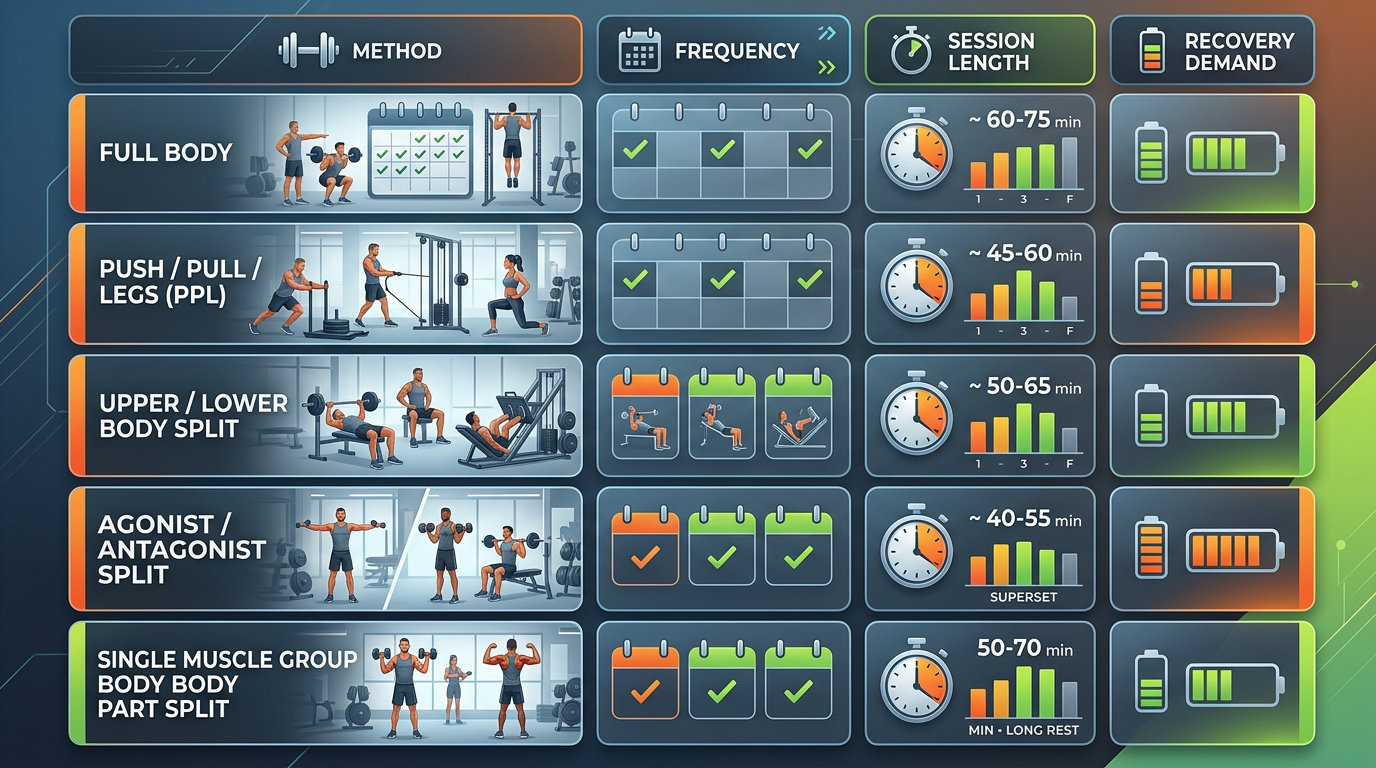
Comparison chart showing the 5 best 3 day workout splits with frequency, session length, and recovery demand for each split type
1. Push/Pull/Legs Split
The push/pull/legs split divides training into three distinct movement patterns. Day one covers all pushing movements for chest, shoulders, and triceps. Day two hits pulling movements for back and biceps. Day three targets legs and typically includes some direct core work.
This split works because it groups muscles by function rather than arbitrary body part divisions. When you bench press, your front delts and triceps already work. Training them together in one session makes programming efficient and allows each muscle group to recover for a full week.
A typical push/pull/legs structure looks like this:
- Push: Bench press 3x5, overhead press 3x8, incline dumbbell press 3x10, lateral raises 3x12, tricep extensions 3x12
- Pull: Deadlift 3x5, barbell rows 3x8, lat pulldowns 3x10, face pulls 3x15, bicep curls 3x12
- Legs: Squat 3x5, Romanian deadlifts 3x8, leg press 3x12, leg curls 3x12, calf raises 4x15
Most lifters run this split Monday/Wednesday/Friday or Tuesday/Thursday/Saturday. The two rest days between legs and push allow full recovery. Apps like Gym Track let you build this template with per-set targets so you know exactly what weight to hit each session.
The main limitation is frequency. Each muscle group gets hit once per week, which works for intermediate and advanced lifters but may not provide enough stimulus for beginners who recover faster and need more practice with movement patterns.
Pros
- Clear division of movement patterns makes programming straightforward
- Allows full recovery with 6-7 days between hitting same muscles
- High volume per muscle group in each session drives hypertrophy
- Works well for tracking progressive overload on compound lifts
Cons
- Only hits each muscle once per week which may limit growth for some lifters
- Leg day can be very fatiguing with both squats and deadlift variations
- Requires consistent 3x weekly schedule or rotation gets disrupted
2. Full Body Split
A full body split trains all major muscle groups in each session. You hit upper body pushing, upper body pulling, and legs three times per week with different exercises or intensities each day.
This approach maximizes frequency. Training each muscle group three times weekly provides more opportunities to practice movement patterns and accumulate volume across the week. For beginners learning to squat, bench, and deadlift, this frequent practice accelerates technical proficiency.
A sample full body 3 day workout split rotation:
- Day 1: Squat 3x5, bench press 3x5, barbell rows 3x8, overhead press 2x10, Romanian deadlifts 2x10
- Day 2: Deadlift 3x5, overhead press 3x5, weighted pullups 3x8, incline press 2x10, leg press 2x12
- Day 3: Front squat 3x8, close grip bench 3x8, cable rows 3x10, dumbbell press 2x12, leg curls 2x12
The variation in exercises and rep ranges across sessions prevents excessive fatigue while maintaining high frequency. Day one might emphasize heavy squats while day three uses front squats at higher reps to accumulate volume without overloading recovery.
Full body splits work particularly well for strength-focused programs. Linear progression models like Starting Strength and StrongLifts use this structure because frequent practice with competition lifts drives rapid strength gains in novice lifters.
The challenge is managing fatigue. Three full body sessions per week tax your entire system. If you are not eating and sleeping enough, recovery becomes difficult. Tracking your performance session to session helps identify when you need a deload.
Pros
- Hits each muscle group 3x weekly for maximum frequency and practice
- Ideal for beginners learning movement patterns and building base strength
- Flexible exercise selection across sessions prevents boredom and overuse
- Allows for auto-regulation by adjusting intensity based on daily readiness
Cons
- Higher systemic fatigue from training everything three times weekly
- Sessions can run long if you include too many exercises per day
- Requires careful management of volume to avoid overtraining
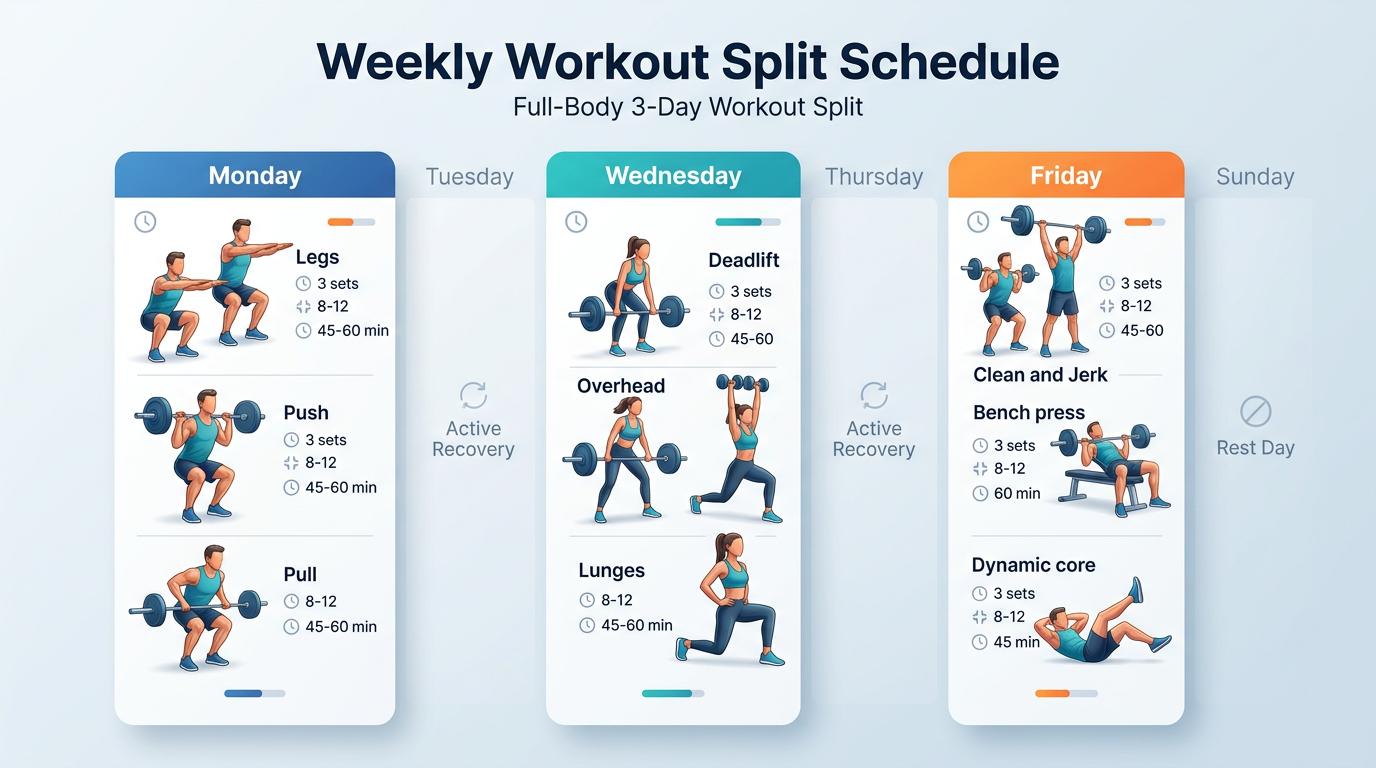
Weekly calendar layout showing a full body 3 day workout split schedule with exercise examples for Monday, Wednesday, and Friday sessions
3. Upper/Lower/Full Body Split
This hybrid approach combines two focused sessions with one full body day. You train upper body on day one, lower body on day two, then hit everything again with lighter loads or different exercises on day three.
The upper/lower/full split provides higher frequency than standard push/pull/legs while managing fatigue better than pure full body training. Each muscle group gets trained 1.5-2 times per week depending on exercise selection.
Here is how it typically structures:
- Upper: Bench press 4x6, barbell rows 4x6, overhead press 3x8, lat pulldowns 3x10, bicep curls 2x12, tricep extensions 2x12
- Lower: Squat 4x6, Romanian deadlifts 3x8, leg press 3x10, leg curls 3x10, calf raises 4x12
- Full: Deadlift 3x5, incline press 3x8, weighted pullups 3x8, front squat 3x8, face pulls 3x15
The first two sessions use higher volumes and intensities on primary lifts. The full body day serves as additional frequency work with slightly reduced loads. This prevents excessive fatigue while still providing enough stimulus for adaptation.
Advanced lifters benefit most from this split. If you have been training for several years and need more volume than once-weekly frequency provides, but cannot handle three high-intensity full body sessions, this middle ground works well.
Programming requires more thought than simpler splits. You need to balance volume and intensity across three different session types. Workout tracking apps with volume tracking help ensure you are not overdoing it on any particular muscle group across the week.
Pros
- Provides 1.5-2x frequency per muscle group for enhanced growth stimulus
- Allows high intensity on focused upper and lower days
- Full body day adds volume without excessive fatigue
- Flexible programming for advanced lifters with specific needs
Cons
- More complex to program than straightforward splits
- Requires careful volume management to avoid overtraining
- May be too much for beginners or those with limited recovery capacity
4. Push/Pull/Full Body Split
Similar to the upper/lower/full approach, this split uses two focused sessions followed by a full body day. Day one covers all pushing movements, day two handles pulling, and day three hits major compounds for each pattern at moderate intensity.
The structure looks like this:
- Push day: Bench press 4x5, overhead press 3x8, incline dumbbell press 3x10, lateral raises 3x12, tricep work 3x12, optional squat or leg press 3x10
- Pull day: Deadlift 4x5, barbell rows 3x8, lat pulldowns 3x10, face pulls 3x15, bicep work 3x12, optional leg curls 3x10
- Full body: Squat 3x6, bench press 3x6, barbell rows 3x8, overhead press 2x10, Romanian deadlifts 2x10
This split works well for lifters who want to emphasize upper body development while maintaining lower body strength. The push and pull days allow high upper body volume while the full body session ensures legs get adequate frequency.
You can structure the full body day as a lighter technique day, using 70-80% of your push/pull day weights to practice movements without accumulating excessive fatigue. This approach works particularly well when cutting, as the reduced intensity on day three helps manage recovery when in a caloric deficit.
Tracking becomes important here. You need to monitor volume per muscle group across the week to ensure balanced development. Apps like Gym Track show weekly volume per muscle group so you can verify your chest, back, and legs are all getting appropriate stimulus.
Pros
- Higher upper body frequency for lifters prioritizing arm and torso development
- Full body day ensures legs get trained without dedicated leg day fatigue
- Flexible intensity distribution across three sessions
- Works well during cuts with reduced day three intensity
Cons
- Lower body frequency may be insufficient for leg-focused goals
- Requires balancing volume across three different session structures
- Full body day can feel redundant if not programmed thoughtfully
5. Antagonist Pairs Split
This split groups opposing muscle groups in each session. Day one pairs chest and back, day two combines shoulders and legs, and day three hits arms and posterior chain or another pairing based on your weak points.
Sample structure:
- Day 1: Bench press 4x6, barbell rows 4x6, incline press 3x10, lat pulldowns 3x10, cable flyes 3x12, cable rows 3x12
- Day 2: Squat 4x6, overhead press 4x6, Romanian deadlifts 3x8, lateral raises 3x12, leg press 3x12, face pulls 3x15
- Day 3: Deadlift 3x5, close grip bench 3x8, leg curls 3x10, tricep extensions 3x12, barbell curls 3x12, calf raises 4x15
Training antagonist muscles in the same session allows for efficient supersets and reduces rest time between exercises. While your chest recovers, you work your back. This approach can cut session length by 15-20 minutes compared to traditional straight sets.
The reduced rest between exercises also provides a cardiovascular stimulus without separate cardio sessions. Your heart rate stays elevated throughout the workout, improving work capacity over time.
This split works best for lifters with limited time who need efficient sessions. The trade-off is slightly reduced performance on later exercises due to accumulated fatigue from minimal rest. If you are chasing absolute strength PRs, traditional rest periods work better.
Tracking superseded exercises requires an app that handles circuit-style training. Gym Track, Hevy, and Strong all support supersets with rest timers between pairs rather than individual exercises.
Pros
- Supersets reduce session time by 15-20 minutes compared to straight sets
- Hits each muscle group roughly 2x weekly with smart exercise selection
- Provides cardiovascular benefit from minimal rest periods
- Allows high volume in time-efficient manner
Cons
- Accumulated fatigue may reduce performance on later exercises
- Requires gym equipment availability for back-to-back exercises
- Not ideal for absolute strength focus due to reduced rest
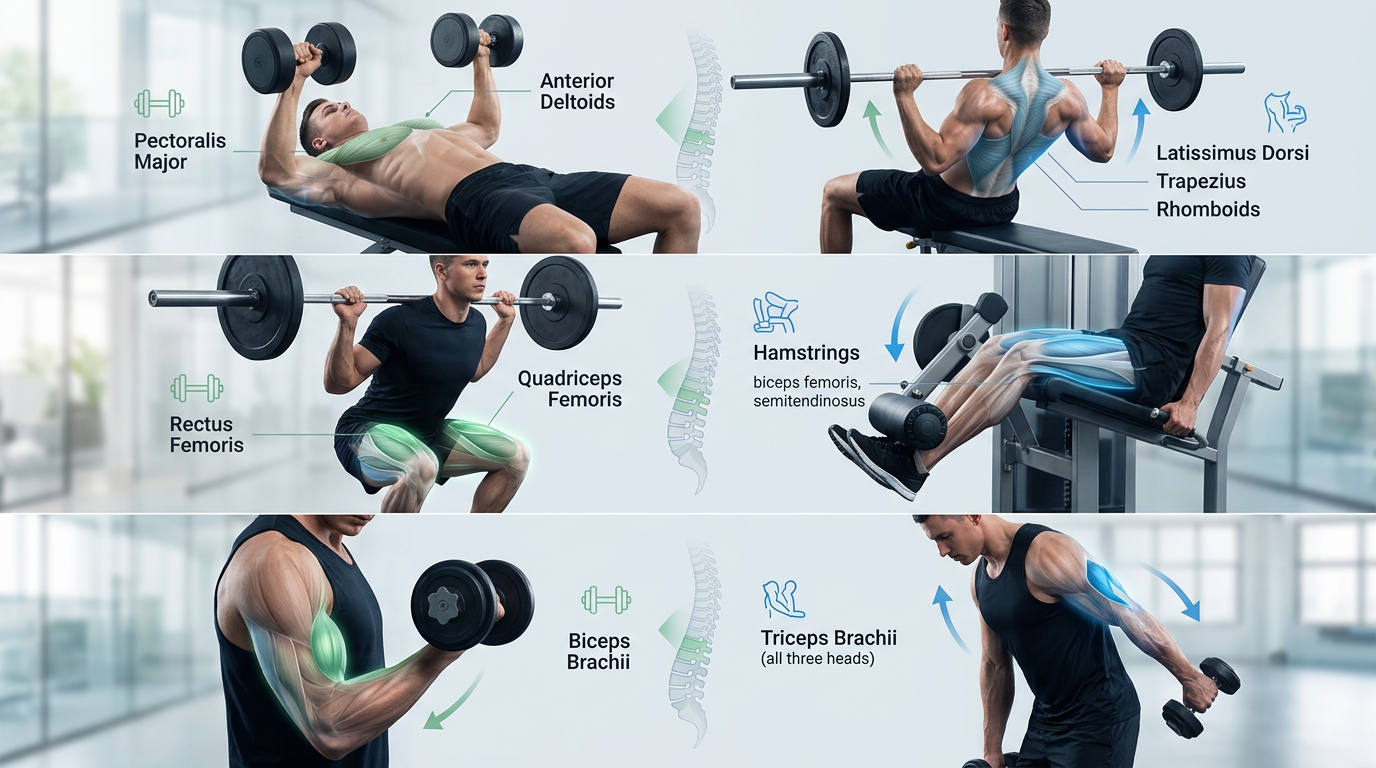
Infographic showing antagonist muscle pairs with examples of exercises for chest/back, quads/hamstrings, and biceps/triceps pairings
How to Choose Your 3 Day Workout Split
Your training age determines which split works best. Beginners need frequent practice with basic movements. Full body splits provide that practice three times weekly. If you have been lifting less than a year, start there.
Intermediate lifters with 1-3 years of consistent training benefit from push/pull/legs or antagonist pairs splits. You have learned the movements and need more volume per muscle group than full body allows without excessive session length.
Advanced lifters can run any split but often benefit from hybrid approaches like upper/lower/full or push/pull/full. These provide higher frequency than once-weekly splits while managing fatigue better than pure full body training.
Recovery Capacity Matters More Than Split Design
Your recovery determines how much volume and frequency you can handle. Sleep, nutrition, and stress outside the gym all impact adaptation. A lifter sleeping 8 hours and eating in a surplus can handle significantly more volume than someone sleeping 6 hours while cutting.
Start conservative with any new split. Add volume gradually based on performance. If your lifts are progressing session to session, your split is working. If you are stalling or regressing, you need more recovery or less volume.
Tracking Makes Any Split More Effective
Workout tracking apps turn your split into a progression system. Apps like Gym Track provide per-set targets based on your previous performance, automatic PR detection, and volume tracking per muscle group. You know exactly what to lift each session and whether you are progressing.
Other solid options include Hevy for social features and exercise library, Strong for simple logging, and Boostcamp for following pre-built programs. Gym Track works best for serious lifters who want fast logging, programs with specific targets, and AI coaching based on training history.
The specific app matters less than consistent tracking. Log every set, rep, and weight. Review your numbers weekly. Adjust your program based on data, not feelings.
Programming Your 3 Day Workout Split for Results
Once you choose a split, you need to program it correctly. Volume, intensity, and exercise selection determine whether your split produces results or spins wheels.
Volume Guidelines Per Muscle Group
Most lifters need 10-20 working sets per muscle group per week for growth. Larger muscles like back and legs can handle the higher end. Smaller muscles like biceps and triceps do fine with 10-12 sets weekly.
Distribute volume based on your split frequency. If you hit chest once per week on a push/pull/legs split, program 12-16 sets on push day. If you run full body and train chest three times weekly, spread those 12-16 sets across three sessions as 4-5 sets per day.
Intensity and Rep Ranges
Vary intensity across your week. Heavy days use 80-90% of your max for 3-6 reps. Moderate days use 70-80% for 6-10 reps. Lighter days use 60-70% for 10-15 reps.
A push/pull/legs split might look like this:
- Push: Heavy bench 4x5 at 85%, moderate overhead press 3x8 at 75%, light accessories 3x12 at 65%
- Pull: Heavy deadlift 3x5 at 85%, moderate rows 4x8 at 75%, light pulldowns 3x12 at 65%
- Legs: Heavy squat 4x5 at 85%, moderate Romanian deadlifts 3x8 at 75%, light leg press 3x12 at 65%
This intensity distribution allows heavy work on primary lifts while accumulating volume through moderate and light work on secondary movements.
Exercise Selection Strategy
Build your split around compound movements. Squat, bench, deadlift, overhead press, and rows form the foundation. These movements train multiple muscle groups and allow progressive overload with measurable weights.
Add isolation exercises after compounds to target specific muscles. If your rear delts are lagging, add face pulls. If your biceps need work, add curls. But compounds come first every session.
Rotate exercise variations every 4-8 weeks to prevent adaptation. Swap flat bench for incline, conventional deadlifts for Romanian, or barbell rows for dumbbell rows. The movement pattern stays similar but the variation provides a new stimulus.
Common Mistakes with 3 Day Splits
Most lifters sabotage their split with a few common errors. Avoid these and your progression improves immediately.
Too Much Volume Too Soon
New lifters see a 20-set chest workout online and copy it. They get sore for a week and make no progress. Start with minimum effective volume, usually 10-12 sets per muscle group weekly, then add sets gradually as you adapt.
Add one set per muscle group every 2-3 weeks. If you start with 3 sets of bench press, go to 4 sets after a few weeks, then 5 sets a few weeks later. Gradual progression prevents overtraining and allows sustainable growth.
Ignoring Progressive Overload
Your split does not build muscle. Progressive overload builds muscle. You need to add weight, reps, or sets over time. If you bench 135 for 3x8 this month and 135 for 3x8 next month, you are not progressing.
Track every workout. Aim to beat your previous performance each session, even by one rep. Small improvements compound into significant strength gains over months.
Skipping Deloads
You cannot push hard every week indefinitely. Fatigue accumulates. Performance drops. You need planned deload weeks every 4-8 weeks where you reduce volume by 40-50% and intensity by 10-20%.
A deload week for push/pull/legs might cut your sets from 4 to 2 per exercise and reduce weights from 85% to 75%. You maintain movement patterns without accumulating fatigue, allowing full recovery before pushing hard again.
Which 3 Day Workout Split Is Best For You
Match your split to your situation:
Choose full body if: You have been lifting less than a year, want to focus on strength gains, need frequent practice with compound movements, or prefer shorter sessions with everything trained each day.
Choose push/pull/legs if: You have 1-3 years of training experience, want clear separation between muscle groups, can commit to a consistent 3x weekly schedule, or prefer one hard session per movement pattern weekly.
Choose upper/lower/full if: You have 3+ years of experience, need more frequency than once weekly, can manage complex programming, or want to emphasize certain muscle groups with smart exercise selection.
Choose push/pull/full if: You want higher upper body frequency, need to maintain but not emphasize lower body, are cutting and need flexible intensity, or like variety in session structure.
Choose antagonist pairs if: You have limited time for training, want efficient sessions under 60 minutes, enjoy superset training, or need cardiovascular benefit from lifting without separate cardio.
The best split is the one you will follow consistently. Pick a structure that fits your schedule, matches your training age, and allows progressive overload. Track your workouts, add weight or reps over time, and adjust based on results.
Frequently Asked Questions
What is the 3-3-3 rule for workouts?
The 3-3-3 rule typically refers to 3 exercises per muscle group, 3 sets per exercise, and 3 workouts per week. This creates a simple framework for beginners to structure training without overcomplicating volume or frequency. Most intermediate lifters need more volume than this rule provides for continued progress.
What kills muscle gains the most?
Inadequate protein intake and insufficient sleep kill muscle gains more than any training variable. You need roughly 0.8-1g protein per pound bodyweight daily and 7-9 hours of quality sleep for optimal recovery. Excessive cardio, chronic stress, and large caloric deficits also significantly impair muscle growth regardless of your training split.
What was Arnold's split?
Arnold Schwarzenegger typically trained 6 days per week using a push/pull split, training each muscle group twice weekly. His 3 day version focused on chest and back on day one, shoulders and arms on day two, and legs on day three. He used high volume with 15-20 sets per muscle group and emphasized the mind-muscle connection.
Does the 6 12 25 method work?
The 6-12-25 method uses three sets of the same exercise at different rep ranges: 6 reps heavy, 12 reps moderate, 25 reps light with minimal rest between sets. This approach accumulates significant volume and metabolic stress in one giant set. It works for hypertrophy but creates substantial fatigue, making it better suited for accessory movements than primary compounds.
Can you build muscle with a 3 day workout split?
You can absolutely build muscle training 3 days per week if you program adequate volume and progressive overload. Most lifters need 10-20 sets per muscle group weekly, which fits easily into three sessions. The key is consistent training over months and years, proper nutrition, and gradually increasing weights or reps over time.
How long should a 3 day split workout take?
Most 3 day workout split sessions take 50-80 minutes depending on your split type and rest periods. Full body workouts run longer due to more exercises per session. Push/pull/legs sessions average 60-75 minutes. Antagonist pair splits using supersets can finish in 50-60 minutes with reduced rest between opposing muscle groups.
Should I do cardio on a 3 day workout split?
Adding cardio to a 3 day workout split depends on your goals and recovery capacity. For muscle building, limit cardio to 2-3 low-intensity sessions of 20-30 minutes on non-lifting days. For fat loss, add 3-4 moderate cardio sessions while ensuring adequate protein and calories to preserve muscle mass and support recovery from lifting.
Final Thoughts on the Best 3 Day Workout Split
The best 3 day workout split matches your training age, recovery capacity, and schedule. Beginners build strength fastest with full body training. Intermediate lifters see great results from push/pull/legs or antagonist pairs. Advanced lifters benefit from hybrid approaches that provide higher frequency without excessive fatigue.
Your split matters less than consistent execution and progressive overload. Pick a structure that fits your life, track every workout, and add weight or reps over time. Use a workout tracking app like Gym Track to log your sessions, monitor volume per muscle group, and ensure you are progressing rather than just training.
The lifters who make the most progress are not the ones with the perfect split. They are the ones who show up three times per week, follow their program, and gradually get stronger over months and years.
Log your next session in Gym Track
Fast set logging, automatic PRs, programs with per-set targets and an AI coach that reads your history. Free on iPhone and Android.
Get the app