 Gym Track
Upper Lower Split Workout: Build Muscle & Strength
October 24, 2026 · 21 min read
Upper Lower Split Workout: Build Muscle & Strength
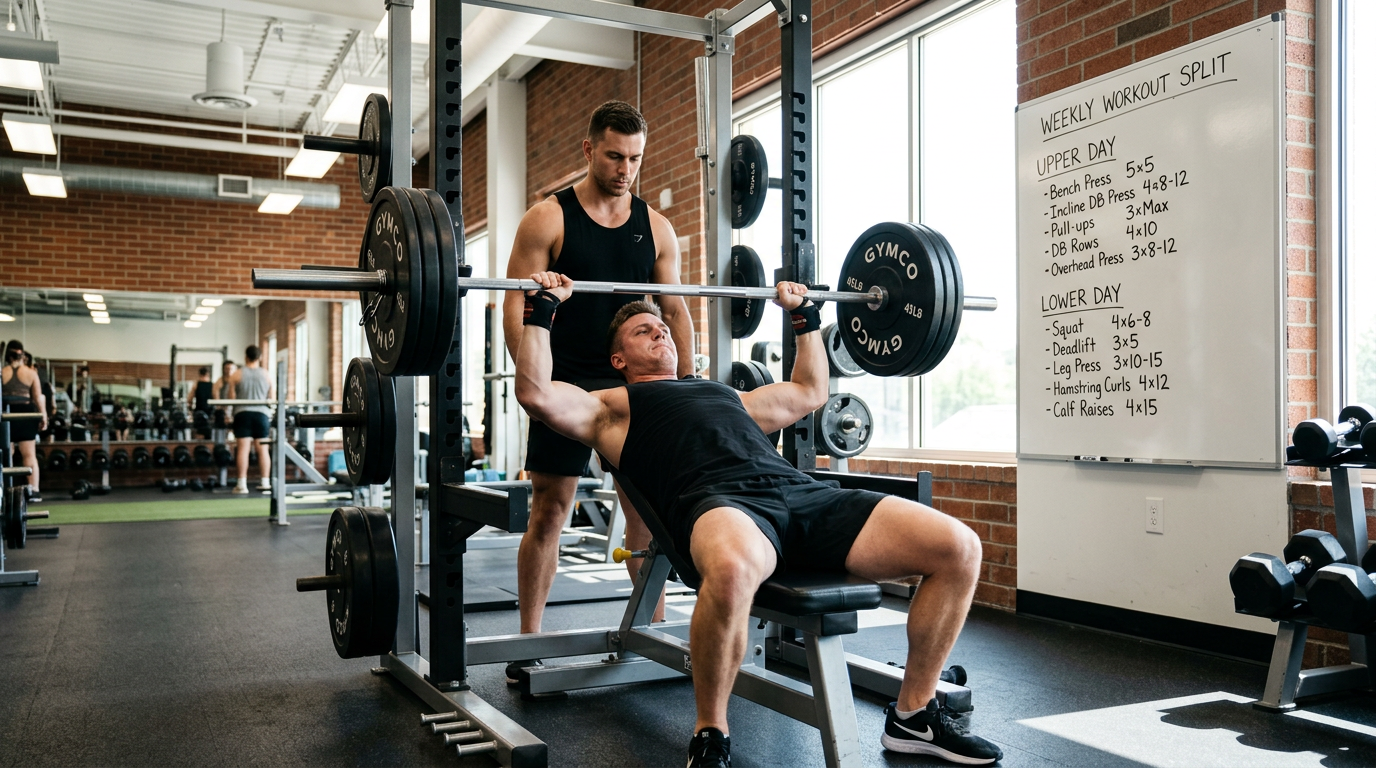
Upper lower split is a training program that divides workouts into upper body days and lower body days, typically performed 4 times per week. This approach allows you to train each muscle group twice weekly with adequate recovery, making it effective for building muscle and strength simultaneously.
You walk into the gym four days a week. Two days you train upper body. Two days you train lower body. Each muscle gets hit twice per week with 48-72 hours between sessions. This is the upper lower split, and it works because it balances training frequency, volume, and recovery better than most other approaches.
The upper lower split sits between full body programs (too much fatigue per session for intermediate lifters) and body part splits (too little frequency for natural lifters). You get enough volume per session to drive adaptation, enough frequency to maximize protein synthesis, and enough recovery to prevent overtraining. Most lifters running an upper lower split properly can add 5-10 pounds to major lifts monthly for 6-12 months.
This guide covers how to structure an upper lower split, which exercises to include, how to program sets and reps, and how to track your progress using a workout app. You will learn the exact framework used by thousands of intermediate lifters to break through plateaus.
Key Takeaways
- Train upper body twice and lower body twice per week on a 4-day schedule for optimal frequency and recovery
- Use compound movements (squat, bench, deadlift, row) as primary exercises with 3-4 sets of 5-8 reps
- Track every workout with specific set and rep targets to ensure progressive overload week to week
- Rest 48-72 hours between training the same muscle groups to allow full recovery
- Expect to add 5-10 pounds monthly to main lifts for 6-12 months when programming and nutrition are dialed in
What Is an Upper Lower Split
An upper lower split divides your training week into upper body workouts and lower body workouts, typically performed on a Monday/Tuesday/Thursday/Friday schedule. You train all upper body muscle groups (chest, back, shoulders, arms) in one session, then all lower body muscle groups (quads, hamstrings, glutes, calves) in another session.
The split looks like this: Upper A on Monday, Lower A on Tuesday, rest Wednesday, Upper B on Thursday, Lower B on Friday, rest Saturday and Sunday. The A and B designations mean you use different exercises or rep ranges on each upper day and each lower day to distribute volume and prevent repetitive strain.
This structure gives you 48-72 hours between training the same muscles. Research shows muscle protein synthesis stays elevated for 24-48 hours after training. Training each muscle twice per week means you hit that window twice instead of once, leading to faster gains than a traditional body part split where you train chest once every 7 days.
Why Lifters Choose Upper Lower Splits
The upper lower split works for lifters who have moved past the beginner stage. If you have been lifting 6-12 months and can no longer recover from full body workouts 3 times per week, an upper lower split lets you increase total weekly volume without destroying yourself in each session.
You get more exercises per muscle group than a full body program allows. On upper days, you might do 3 chest exercises, 3 back exercises, 2 shoulder exercises, and 2 arm exercises. On lower days, you might do 2 squat variations, 2 hinge variations, and direct glute and calf work. This volume spread across two sessions per muscle group drives hypertrophy better than cramming everything into one weekly session.
The split also fits most work schedules. Four training days with three rest days gives you flexibility. You can shift training days if something comes up, as long as you maintain the upper/lower/rest/upper/lower pattern.
Upper Lower Split vs Other Training Splits
Compared to full body workouts, the upper lower split allows more volume per muscle group per week. A full body program might include 1-2 chest exercises per session for 3-6 total sets per week. An upper lower split includes 3-4 chest exercises across two upper days for 12-16 total sets per week.
Compared to a traditional body part split (chest day, back day, leg day, shoulder day, arm day), the upper lower split provides better frequency. Training chest once per week means you only trigger muscle protein synthesis once per week. Training chest twice per week doubles that stimulus.
Compared to push/pull/legs splits, the upper lower split requires fewer training days. A PPL split typically runs 6 days per week. An upper lower split runs 4 days per week, making it more sustainable for lifters with jobs, families, or other commitments.
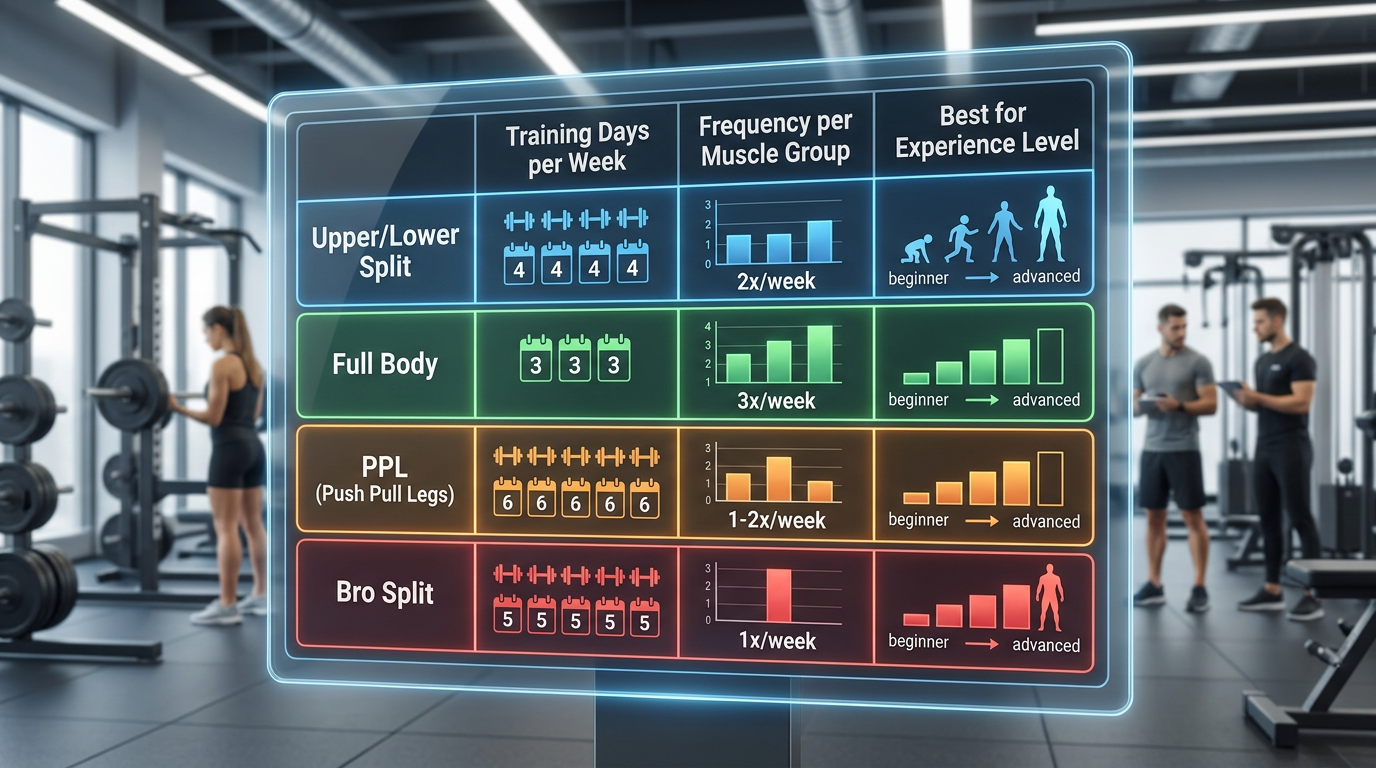
Comparison table showing upper lower split vs full body vs PPL vs bro split, with columns for training days per week, frequency per muscle group, and best for which experience level
How to Structure Your Upper Lower Split
Structure your upper lower split with 4-6 exercises per session, starting with compound movements for 3-4 sets of 5-8 reps, then moving to isolation work for 3 sets of 8-12 reps. Your first exercise should be the heaviest compound lift of the day, performed when you are freshest.
Upper A might start with barbell bench press 4x6, then move to barbell rows 4x6, then dumbbell shoulder press 3x8, then cable flyes 3x10, then bicep curls 3x10, then tricep pushdowns 3x10. Lower A might start with back squats 4x6, then Romanian deadlifts 3x8, then Bulgarian split squats 3x10, then leg curls 3x10, then calf raises 3x12.
Upper B and Lower B should use different exercises or rep ranges to distribute stress. Upper B might use incline dumbbell press instead of flat barbell bench, and weighted pullups instead of barbell rows. Lower B might use front squats instead of back squats, and trap bar deadlifts instead of Romanian deadlifts.
Exercise Selection for Upper Days
Choose one horizontal push (bench press, dumbbell press), one horizontal pull (barbell row, dumbbell row, cable row), one vertical push (overhead press, dumbbell shoulder press), and one vertical pull (pullups, lat pulldowns, cable pulldowns). These four movement patterns cover all major upper body muscles.
Add isolation work based on weak points. If your arms lag, add 2-3 arm exercises per upper day. If your rear delts are underdeveloped, add face pulls or reverse flyes. If your chest is strong but back is weak, do 4 back exercises and 2 chest exercises.
Alternate between barbell and dumbbell variations across Upper A and Upper B days. Barbells allow heavier loads. Dumbbells allow greater range of motion and reduce injury risk from repetitive barbell work.
Exercise Selection for Lower Days
Choose one squat variation (back squat, front squat, safety bar squat, goblet squat) and one hinge variation (conventional deadlift, Romanian deadlift, trap bar deadlift, good mornings). Squats target quads and glutes. Hinges target hamstrings, glutes, and lower back.
Add unilateral work to fix imbalances and build stability. Bulgarian split squats, lunges, and single leg Romanian deadlifts force each leg to work independently. Most lifters have one leg stronger than the other. Unilateral work evens this out.
Include direct glute and calf work at the end. Hip thrusts, glute bridges, and cable kickbacks for glutes. Standing and seated calf raises for calves. These muscles recover quickly and benefit from higher rep ranges (12-20 reps per set).
Sample 4-Day Upper Lower Split
Here is a complete 4-day upper lower split you can run for 8-12 weeks:
Monday - Upper A:
- Barbell Bench Press: 4 sets x 6 reps
- Barbell Rows: 4 sets x 6 reps
- Dumbbell Shoulder Press: 3 sets x 8 reps
- Lat Pulldowns: 3 sets x 10 reps
- Dumbbell Bicep Curls: 3 sets x 10 reps
- Tricep Rope Pushdowns: 3 sets x 10 reps
Tuesday - Lower A:
- Back Squat: 4 sets x 6 reps
- Romanian Deadlift: 3 sets x 8 reps
- Bulgarian Split Squat: 3 sets x 10 reps per leg
- Leg Curls: 3 sets x 10 reps
- Standing Calf Raises: 4 sets x 12 reps
Thursday - Upper B:
- Incline Dumbbell Press: 4 sets x 8 reps
- Weighted Pullups: 4 sets x 6 reps
- Overhead Press: 3 sets x 8 reps
- Cable Flyes: 3 sets x 12 reps
- Hammer Curls: 3 sets x 10 reps
- Overhead Tricep Extension: 3 sets x 10 reps
Friday - Lower B:
- Front Squat: 4 sets x 8 reps
- Trap Bar Deadlift: 3 sets x 6 reps
- Walking Lunges: 3 sets x 12 reps per leg
- Leg Extensions: 3 sets x 12 reps
- Seated Calf Raises: 4 sets x 15 reps
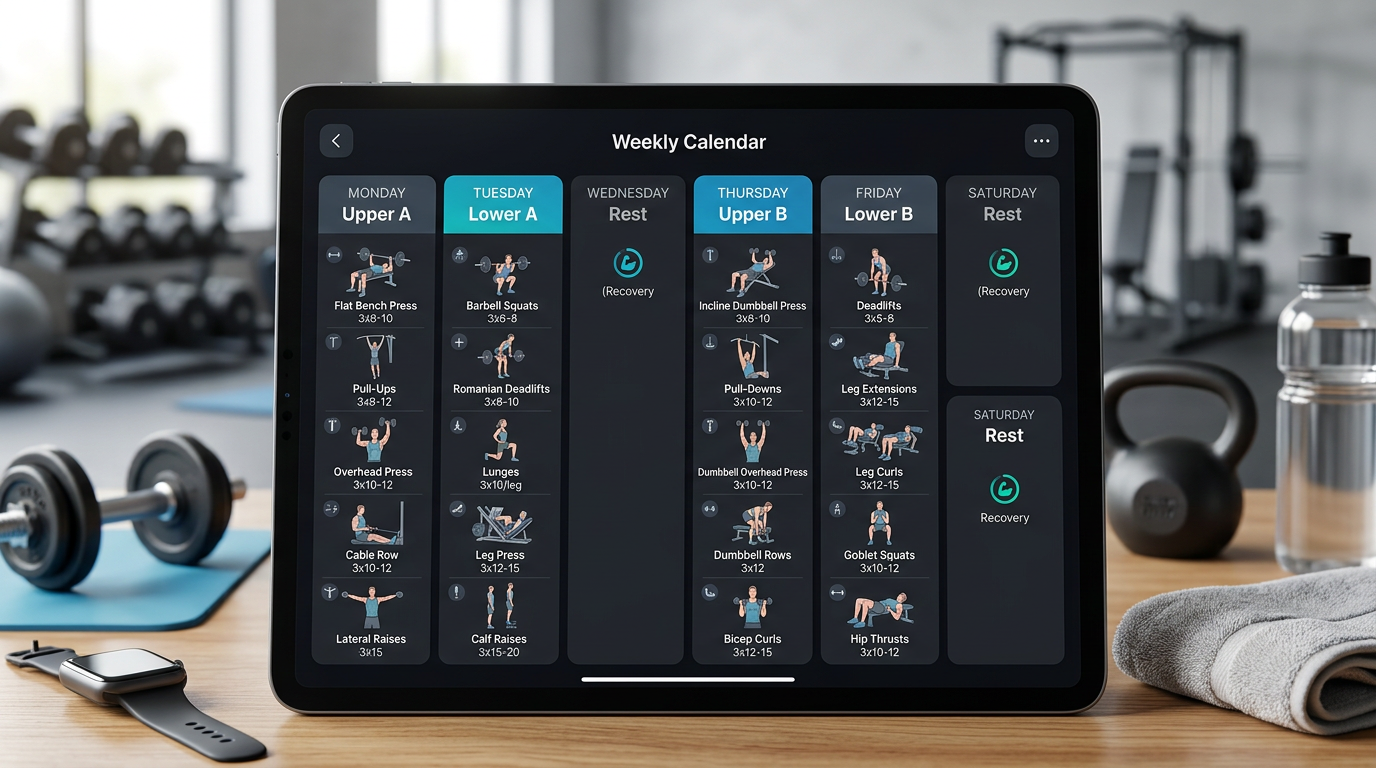
Weekly calendar layout showing Monday Upper A, Tuesday Lower A, Wednesday Rest, Thursday Upper B, Friday Lower B, Saturday and Sunday Rest with example exercises listed for each training day
Sets, Reps, and Progressive Overload
Use 3-4 sets of 5-8 reps for main compound lifts, 3 sets of 8-12 reps for secondary exercises, and add 2.5-5 pounds per week when you hit the top of the rep range for all sets. Progressive overload means increasing the training stimulus over time, and adding weight is the simplest way to do this.
If your program calls for bench press 4x6 and you complete 6 reps on all 4 sets at 185 pounds, add 5 pounds next session. If you only hit 6/6/5/4 reps, stay at 185 pounds until you can complete 6 reps on all sets. This is double progression: you progress reps first, then weight.
For isolation exercises, use slower progressions. Add weight when you hit 12 reps on all sets. For bicep curls, this might mean staying at 30 pound dumbbells for 3-4 weeks before moving to 35 pounds. Isolation exercises fatigue smaller muscles that need more recovery time.
Rest Periods Between Sets
Rest 3-5 minutes between sets of heavy compound lifts (squat, deadlift, bench press, rows). Your nervous system needs this time to recover for maximum force production. Cutting rest to 90 seconds on heavy sets reduces the weight you can lift and decreases the training stimulus.
Rest 2-3 minutes between sets of secondary compound exercises (overhead press, Romanian deadlifts, pullups). These exercises use multiple muscle groups but at lower intensities than your main lift.
Rest 60-90 seconds between sets of isolation exercises (curls, extensions, lateral raises, calf raises). These exercises target single muscle groups and do not tax your nervous system as heavily. Shorter rest periods increase metabolic stress, which contributes to hypertrophy.
When to Deload
Take a deload week every 6-8 weeks. A deload means reducing volume or intensity to allow accumulated fatigue to dissipate. You can cut sets in half (2 sets instead of 4), reduce weight by 30-40%, or take the entire week off.
Signs you need a deload: joints ache, sleep quality drops, motivation tanks, lifts stall or regress for 2+ weeks, or you feel beat up despite adequate nutrition and sleep. Deloads are not wasted weeks. They allow supercompensation, where you come back stronger than before.
After a deload, you should hit new PRs within 1-2 weeks. If you do not, your programming or nutrition needs adjustment.
Tracking Your Upper Lower Split Workouts
Use a workout tracking app to log every set, rep, and weight so you know exactly what to lift each session and can measure progress week over week. Relying on memory or paper notebooks leads to missed progressions and wasted training time.
Apps like Gym Track, Hevy, Strong, and Boostcamp let you create custom programs with per-set targets. You open the app, see that today calls for bench press 4x6 at 185 pounds, complete the sets, log the weight and reps, and the app shows whether you hit your target. Next week, the app suggests 190 pounds based on your performance.
Gym Track is built for lifters running structured programs like upper lower splits. You get per-set targets (not just exercise names), automatic PR detection when you hit a new max, projected 1RM calculations, and an AI coach that reads your training history to suggest adjustments. If your squat is progressing but your bench is stalled, the AI flags it and suggests form checks or accessory work.
Why Tracking Matters for Upper Lower Splits
Upper lower splits involve 16-24 exercises per week across 4 sessions. Remembering what weight you used for Bulgarian split squats 4 days ago is impossible. Tracking ensures you apply progressive overload consistently.
Tracking also reveals patterns. If your Lower A squat progresses but your Lower B front squat stalls, you might be doing too much volume on Lower A and arriving at Lower B too fatigued. If your Upper B performance drops every week, you might need an extra rest day between Upper A and Lower A.
Apps with automatic PR detection give you instant feedback. Hitting a new 5RM on deadlifts feels good. Seeing the app confirm it with a badge or notification reinforces the behavior and keeps motivation high.
Comparing Workout Tracking Apps
Hevy offers a clean interface and social features where you can follow other lifters and share workouts. Best for lifters who want community accountability.
Strong provides simple logging with exercise history graphs. Best for lifters who want no-frills tracking without programs or coaching.
Boostcamp includes free programs from well-known coaches. Best for lifters who want to follow a specific program without customization.
Gym Track combines fast logging (sets, reps, weight, and RPE in seconds), structured programs with per-set targets, automatic PR detection, projected 1RM, and an AI coach that analyzes your history. Best for serious lifters running upper lower splits or other intermediate programs who want data-driven feedback.
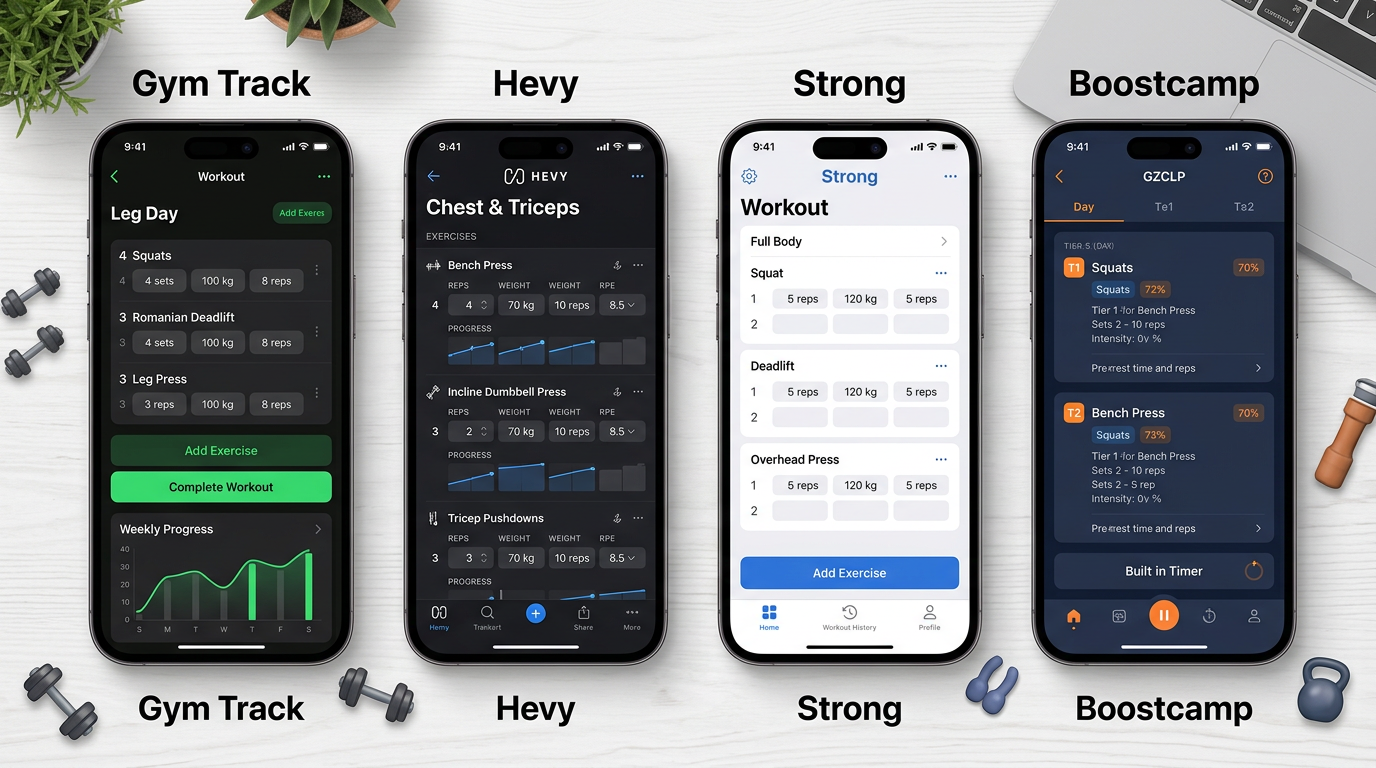
Screenshot comparison showing workout logging interface for Gym Track, Hevy, Strong, and Boostcamp apps side by side with key features highlighted
Common Upper Lower Split Mistakes
The biggest mistake is treating every session like a max effort day. You do not need to grind every set to failure. Leaving 1-2 reps in the tank (RPE 8-9) on compound lifts allows you to recover and perform well in the next session. Training to failure on Monday upper day means your Thursday upper day suffers.
Another mistake is neglecting weak points. If your lower back is always sore but your quads feel fine, you are likely doing too much hinge volume relative to squat volume. Adjust your exercise selection. If your rear delts are underdeveloped, add face pulls or reverse flyes to both upper days.
Skipping deloads leads to overtraining. You might feel strong for 8-10 weeks, then hit a wall where every lift feels heavy and joints hurt. Take a deload week before you need it, not after you are already overtrained.
Not Enough Lower Body Volume
Many lifters treat lower days as an afterthought. They do 2 exercises (squat and deadlift) then leave. Your legs have more muscle mass than your upper body and can handle more volume. Each lower day should include 4-6 exercises covering squats, hinges, unilateral work, and isolation.
Quads, hamstrings, and glutes recover quickly compared to your nervous system. You can train legs with high volume (15-20 sets per muscle group per week) without overtraining, as long as you manage intensity on the main lifts.
Ignoring Recovery Factors
Training is the stimulus. Growth happens during recovery. If you run an upper lower split but sleep 5 hours per night and eat 1500 calories per day, you will not gain muscle or strength.
Aim for 7-9 hours of sleep per night. Eat 0.8-1 gram of protein per pound of bodyweight per day. Maintain a calorie surplus of 200-300 calories if your goal is muscle gain, or maintenance calories if your goal is recomposition. Drink enough water to stay hydrated (half your bodyweight in ounces is a good baseline).
Manage stress outside the gym. High cortisol from work stress or relationship problems impairs recovery just like overtraining does. If you cannot control external stress, reduce training volume slightly to compensate.
Upper Lower Split Variations
The standard 4-day upper lower split works for most intermediate lifters, but you can adjust frequency and volume based on your schedule and recovery capacity.
3-Day Upper Lower Split
Run upper/lower/upper one week, then lower/upper/lower the next week. This gives you 3 training days per week with each muscle group hit 1.5 times per week on average. Best for lifters with limited time or those who need more recovery due to age, stress, or other factors.
Week 1: Monday Upper A, Wednesday Lower A, Friday Upper B. Week 2: Monday Lower B, Wednesday Upper A, Friday Lower A. Continue alternating.
5-Day Upper Lower Split
Add a fifth day focused on weak points or lagging muscle groups. If your arms are small, add an arm day. If your shoulders are weak, add a shoulder day. If your lower back is a limiting factor, add a deadlift variation day with lighter weights and higher reps.
Structure: Monday Upper A, Tuesday Lower A, Wednesday Arms, Thursday Upper B, Friday Lower B, Saturday and Sunday rest. This increases weekly volume without overloading any single session.
Upper Lower Power Hypertrophy Split
Use lower reps (3-5) and heavier weight on one upper day and one lower day, then higher reps (8-12) and moderate weight on the other upper day and lower day. This is called PHUL (Power Hypertrophy Upper Lower).
Monday Upper Power: Bench press 4x5, rows 4x5, overhead press 3x5. Tuesday Lower Power: Squat 4x5, deadlift 3x5. Thursday Upper Hypertrophy: Incline dumbbell press 4x10, cable rows 4x10, lateral raises 3x12. Friday Lower Hypertrophy: Leg press 4x10, leg curls 4x10, lunges 3x12.
PHUL combines strength and hypertrophy training in one program. The power days build strength. The hypertrophy days build muscle. This approach works well for lifters who want to maximize both goals simultaneously.
Nutrition for Upper Lower Split Training
Training 4 days per week with an upper lower split requires adequate fuel. Your body needs energy to perform the workouts and nutrients to recover and build muscle.
Calorie Intake
For muscle gain, eat 200-300 calories above maintenance. Calculate maintenance by multiplying your bodyweight in pounds by 15 (moderate activity level). A 180 pound lifter needs roughly 2700 calories to maintain weight, so 2900-3000 calories to gain.
For fat loss while maintaining strength, eat 300-500 calories below maintenance. A 180 pound lifter would eat 2200-2400 calories. Expect slower strength gains or maintenance of current strength levels during a cut.
For recomposition (losing fat while gaining muscle), eat at maintenance calories. This works best for beginners or detrained lifters returning after a layoff. Intermediate lifters with 2+ years of consistent training find recomposition slower than dedicated bulk or cut phases.
Protein Timing and Amount
Eat 0.8-1 gram of protein per pound of bodyweight per day. A 180 pound lifter needs 144-180 grams of protein daily. Spread this across 4-5 meals for optimal muscle protein synthesis.
Timing matters less than total daily intake, but having protein within 2 hours post-workout supports recovery. A post-workout meal with 30-40 grams of protein and 40-60 grams of carbs works well.
Pre-workout nutrition affects performance. Eat a meal with protein and carbs 2-3 hours before training. If you train early morning, a smaller snack 30-60 minutes before (banana, protein shake) provides quick energy without causing digestive issues.
Carbs and Fats
Carbs fuel high-intensity training. Aim for 2-3 grams per pound of bodyweight on training days. A 180 pound lifter needs 360-540 grams of carbs on training days. Focus on rice, potatoes, oats, bread, pasta, and fruit.
Fats support hormone production. Aim for 0.3-0.5 grams per pound of bodyweight per day. A 180 pound lifter needs 54-90 grams of fat daily. Include sources like olive oil, nuts, avocados, fatty fish, and whole eggs.
On rest days, you can reduce carbs slightly (by 50-100 grams) and keep protein and fats the same. This creates a small calorie deficit on rest days while maintaining muscle recovery.
Who Should Run an Upper Lower Split
Upper lower splits work best for intermediate lifters with 6-24 months of consistent training experience. You should be able to squat 1.5x bodyweight, bench press 1x bodyweight, and deadlift 2x bodyweight before running an upper lower split. These strength standards indicate you have built a base and can handle the volume.
If you are a beginner (less than 6 months of training), stick with a full body program 3 times per week. You do not need the volume or frequency of an upper lower split yet. Full body programs allow you to practice movements more frequently and build work capacity.
If you are advanced (3+ years of consistent training, close to genetic potential), you might benefit from higher frequency programs like push/pull/legs 6 days per week or body part splits with specialization phases. Advanced lifters need more volume per muscle group to continue progressing.
Upper Lower Split for Busy Schedules
The 4-day structure fits well if you work a standard job. Train Monday, Tuesday, Thursday, Friday. Rest Wednesday, Saturday, Sunday. Each session takes 60-75 minutes including warmup and cooldown.
If your schedule changes week to week, the upper lower split offers flexibility. You can shift days as long as you maintain the pattern: upper, lower, rest, upper, lower, rest, rest. Avoid training upper or lower on back-to-back days without rest.
Upper Lower Split for Home Gyms
You can run an upper lower split with minimal equipment. A barbell, squat rack, bench, and pullup bar cover most exercises. Substitute cable exercises with resistance bands. Substitute machines with dumbbell or barbell variations.
Home gym upper lower split: Use barbell bench press, barbell rows, overhead press, pullups, back squats, deadlifts, and dumbbell accessories. This covers all movement patterns without needing a commercial gym.
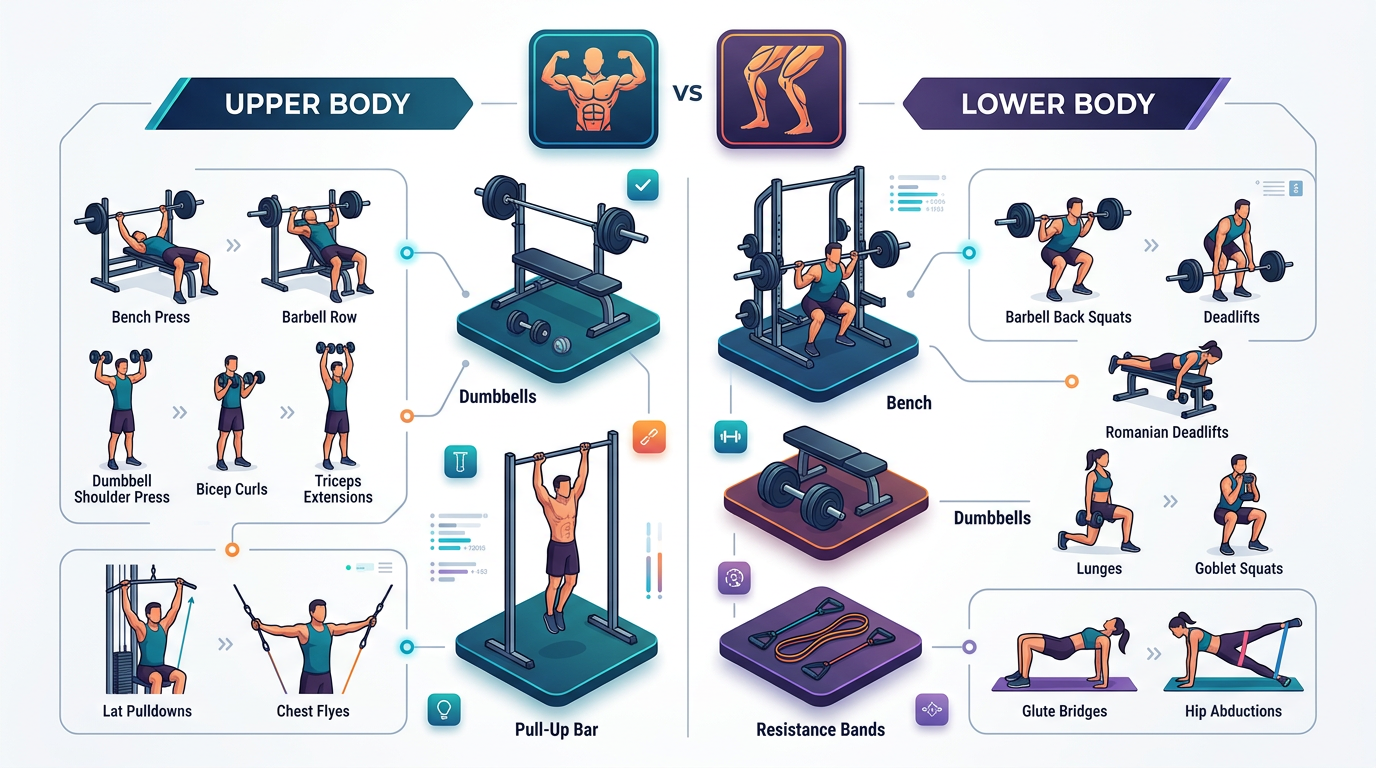
Infographic showing equipment needed for home gym upper lower split including barbell, squat rack, bench, pullup bar, dumbbells, and resistance bands with exercise examples for each piece of equipment
Frequently Asked Questions
How many days per week should you do an upper lower split?
You should do an upper lower split 4 days per week, training upper body twice and lower body twice with at least 48 hours between sessions targeting the same muscle groups. This frequency maximizes muscle protein synthesis while allowing adequate recovery for intermediate lifters.
Is upper lower split better than push pull legs?
Upper lower split is better if you can only train 4 days per week, while push pull legs works better for 6-day schedules. Both provide similar muscle-building results when volume and intensity are matched. Choose based on your available training days and recovery capacity.
Can beginners do an upper lower split?
Beginners can do an upper lower split but full body programs 3 times per week are more effective for the first 6-12 months. Beginners need more frequent practice with compound movements and less volume per session. Transition to upper lower splits once you can squat 1.5x bodyweight.
How long should upper lower workouts take?
Upper lower workouts should take 60-75 minutes including warmup and cooldown. Plan for 4-6 exercises per session with 3-4 sets each and 2-5 minute rest periods between sets of compound lifts. Longer sessions indicate too many exercises or excessive rest.
What exercises should be in an upper lower split?
Upper days should include bench press, rows, overhead press, and pullups for main movements. Lower days should include squats, deadlifts or hinges, and unilateral work like lunges. Add 2-3 isolation exercises per session targeting weak points like arms, calves, or rear delts.
How do you progress on an upper lower split?
Progress on an upper lower split by adding 2.5-5 pounds to compound lifts when you complete all prescribed reps for all sets. Use double progression: increase reps first until you hit the top of the range, then add weight. Track every workout to ensure consistent progression.
Can you build muscle with an upper lower split?
You can build significant muscle with an upper lower split by training each muscle group twice per week with 12-20 sets per muscle per week. Combine this with a 200-300 calorie surplus and 0.8-1 gram protein per pound bodyweight daily for optimal hypertrophy results.
Conclusion
The upper lower split gives intermediate lifters the frequency and volume needed to build muscle and strength without overtraining. Four training days per week, each muscle hit twice, with 48-72 hours recovery between sessions. This structure works because it balances stimulus and recovery better than full body programs or traditional body part splits.
Program your upper lower split with compound lifts first (3-4 sets of 5-8 reps), then secondary exercises (3 sets of 8-12 reps), then isolation work (3 sets of 10-15 reps). Track every workout with an app that logs sets, reps, and weight so you can apply progressive overload consistently. Eat enough protein (0.8-1 gram per pound bodyweight) and calories (200-300 above maintenance for muscle gain) to support your training.
Most lifters running an upper lower split properly add 5-10 pounds to main lifts monthly for 6-12 months before needing a program change. Use a workout tracking app like Gym Track to log your sessions, track PRs automatically, and get AI coaching based on your training history.
Log your next session in Gym Track
Fast set logging, automatic PRs, programs with per-set targets and an AI coach that reads your history. Free on iPhone and Android.
Get the app