 GymTrack
Strong App Alternatives in 2026: Better Workout Trackers
November 1, 2026 · 20 min read
Strong App Alternatives in 2026: Better Workout Trackers
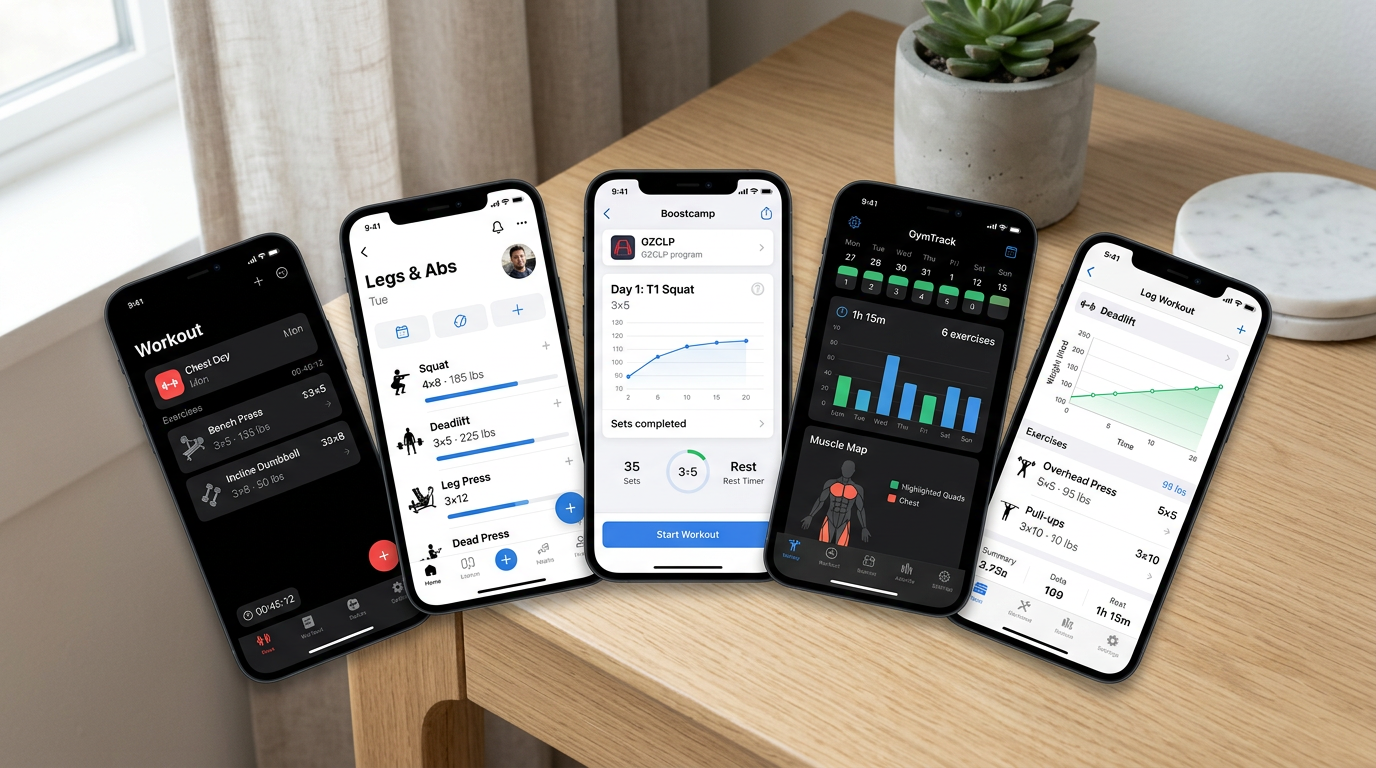
Strong app alternatives are workout tracking apps that offer different features for logging strength training. Top options include Hevy for social features, Boostcamp for free programs, GymTrack for fast logging with AI coaching, and StrengthLog for science-based training, each excelling in specific areas Strong users seek.
You have been using Strong for months, maybe years. The interface is clean, logging is straightforward, and it does the job. But you have hit a wall. Maybe you want better program features, faster logging between sets, or an AI coach that actually reads your training history instead of generic advice.
The good news: several strong app alternatives have emerged that address these gaps. Some offer superior program structures with per-set targets. Others nail the logging speed. A few provide coaching features that learn from your actual lifts.
This guide compares the best workout trackers for lifters who have outgrown Strong or want to see what else is available. We tested each app across logging speed, program features, analytics, and value. No hype, just what each app does well and who it is built for.
Key Takeaways
- Hevy offers the best social features and community challenges while maintaining Strong-like simplicity
- Boostcamp provides the largest free program library with structured periodization from top coaches
- GymTrack delivers the fastest logging interface with automatic PR detection and AI coaching from your history
- StrengthLog combines science-based programs with detailed analytics for intermediate to advanced lifters
- Most alternatives offer free tiers that match or exceed Strong's paid features
Why Lifters Look for Strong App Alternatives
Strong built its reputation on simplicity. Open the app, log your sets, move on. For beginners, this works perfectly. But as you progress, limitations appear.
Limited Program Features
Strong lets you create routines, but it lacks per-set targets and automatic progression schemes. If you are running a program with specific percentages or RPE targets for each set, you are manually calculating or keeping notes outside the app. This slows you down between sets and increases the chance of missing prescribed loads.
Programs like 5/3/1, Texas Method, or any block periodization require you to track which week you are in and what percentages to use. Strong does not handle this automatically.
Basic Analytics and Progress Tracking
Strong shows you previous workouts and basic charts. It does not project your 1RM automatically, flag when you hit PRs without you noticing, or analyze training volume trends over mesocycles. For lifters chasing specific strength goals, these gaps matter.
You want to know if your squat volume is trending up, if you are recovering properly based on performance metrics, or if your bench has stalled for three weeks. Strong requires manual tracking to spot these patterns.
No AI Coaching or Adaptive Features
Strong does not learn from your training history. It will not suggest deload weeks, flag overreaching, or adjust your program based on performance. The app is a digital notebook, not a training partner.
As lifters accumulate years of data, they want insights. Which exercises drive your squat up most? When do you typically need a deload? What rep ranges have you responded to best? Strong does not answer these questions.
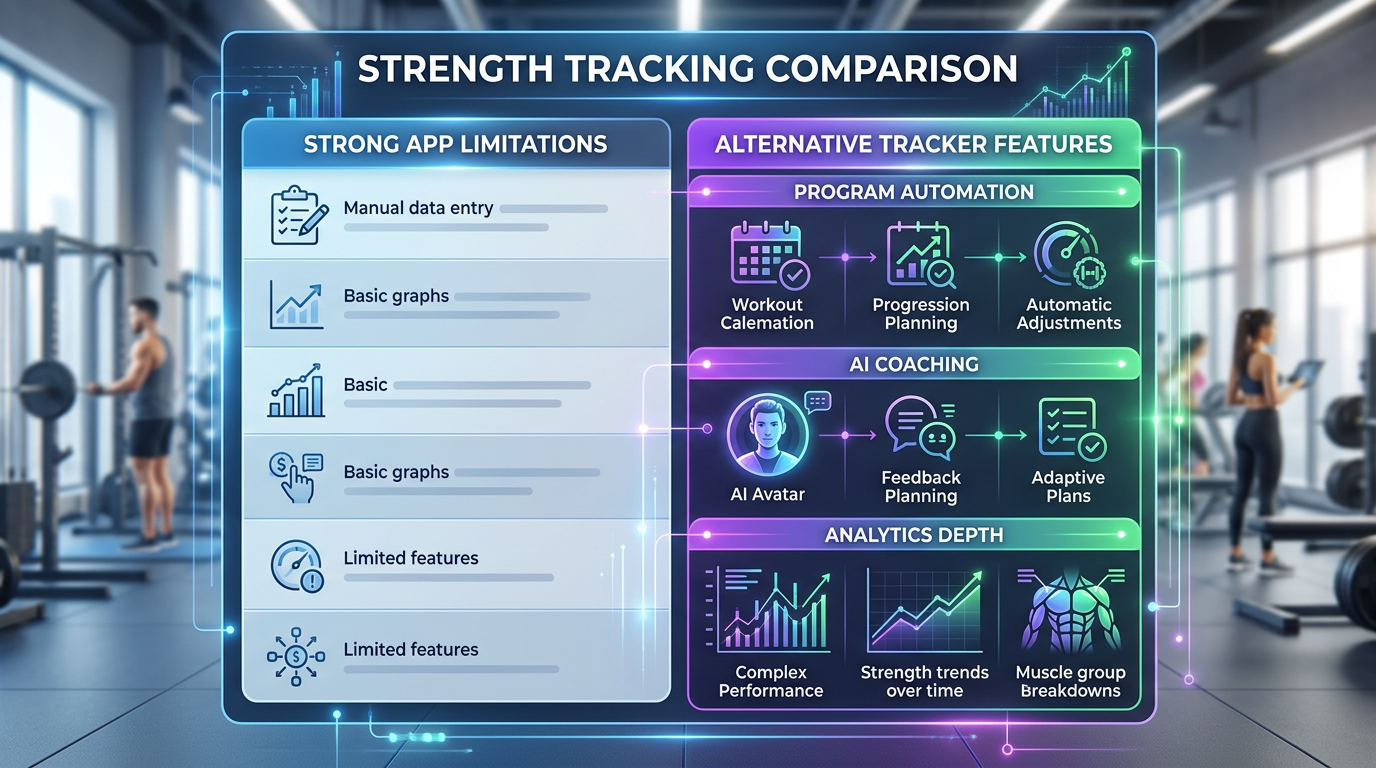
Comparison table showing Strong app limitations versus alternative workout tracker features including program automation, AI coaching, and analytics depth
Best Strong App Alternatives for Different Lifting Goals
No single app is best for everyone. The right strong app alternatives depend on whether you prioritize speed, programs, social features, or analytics. Here are the top options tested across six months of real training.
Hevy: Best for Social Lifters
Hevy looks and feels similar to Strong but adds a social layer. You can follow friends, share workouts, and join challenges. The logging interface is equally fast, with plate calculator and rest timers built in.
Hevy excels if you lift with friends or want community motivation without sacrificing logging simplicity. The feed shows what others are doing, and challenges add competitive structure to your training blocks.
Key features:
- Social feed with workout sharing and comments
- Community challenges with leaderboards
- Plate calculator and rest timer
- Routine templates and workout history
- Free tier includes unlimited workouts
- Premium adds analytics and custom exercise videos
Hevy works best for lifters who train with partners, want accountability through social features, or enjoy competitive challenges. If you lift alone and do not care about social aspects, the extra features add little value.
Boostcamp: Best Free Program Library
Boostcamp built the largest library of free structured programs from legitimate coaches. You get nSuns, GZCL, Greg Nuckols 28 Free Programs, and dozens more with full periodization and progression schemes.
Each program includes per-set targets with percentages calculated automatically from your training maxes. If you want to follow a proven program without building it yourself or paying for coaching, Boostcamp delivers the most value.
Key features:
- Over 50 free programs from respected coaches
- Automatic percentage calculations from training maxes
- Per-set targets with weight and rep prescriptions
- Progress tracking across program phases
- Exercise swap options within programs
- Completely free with no premium tier
Boostcamp suits lifters who want structure, follow established programs, and prefer not to program themselves. The tradeoff is less flexibility for custom routines and no AI coaching features.
GymTrack: Best for Fast Logging and AI Coaching
GymTrack prioritizes logging speed above everything. You can log a full set in under three seconds with smart defaults and gesture controls. The app detects PRs automatically, projects 1RM after every set, and includes an AI coach trained on your actual lifting history.
GymTrack is built for lifters who want zero friction during workouts, automatic progress tracking, and coaching insights based on their real data. The interface assumes you know what you are doing and gets out of your way.
Key features:
- Sub-3-second set logging with smart defaults
- Automatic PR detection across all rep ranges
- Projected 1RM calculated after each set
- AI coach analyzes your training history for personalized advice
- Program builder with per-set targets and RPE
- Free for iOS and Android with no feature limits
GymTrack works best for experienced lifters who train 3-6 days per week, follow programs with specific targets, and want coaching without paying for a human. If you are a beginner who needs extensive exercise libraries and form videos, other apps provide more guidance.
StrengthLog: Best for Science-Based Training
StrengthLog comes from the team behind Stronger By Science. The app includes science-backed programs, detailed analytics, and progression tracking designed around research principles.
Programs include automatic periodization with deload weeks, volume landmarks, and progression recommendations based on performance. Analytics show training volume by muscle group, frequency distribution, and intensity zones across mesocycles.
Key features:
- Science-based programs with automatic periodization
- Volume tracking by muscle group
- Intensity distribution analysis
- Progression recommendations based on performance
- Exercise library with muscle activation data
- Free tier with basic features, premium for full analytics
StrengthLog suits intermediate to advanced lifters who care about training principles, want detailed analytics, and prefer evidence-based programming. The interface is more complex than Strong, which some lifters appreciate and others find cluttered.
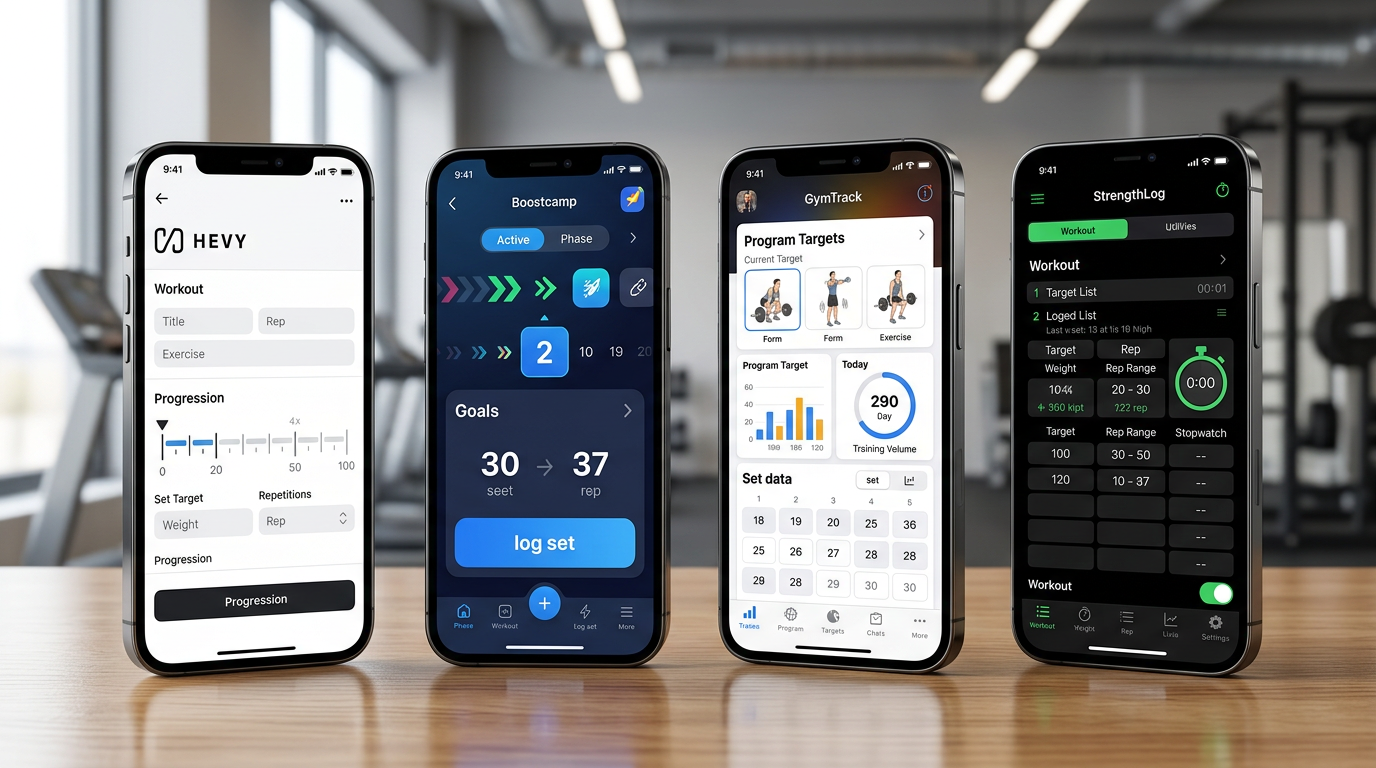
Side-by-side screenshots comparing logging interfaces of Hevy, Boostcamp, GymTrack, and StrengthLog showing set entry speed and program target displays
Key Features to Compare When Choosing Strong App Alternatives
Not all workout trackers prioritize the same features. Understanding what matters most to your training helps narrow options quickly.
Logging Speed and Interface Design
You spend 30-90 seconds between sets. The app should not eat into that rest period. Fast logging means fewer taps, smart defaults that remember your last weight, and gesture controls for common actions.
Test this by timing how long it takes to log a standard 5x5 workout. Strong typically requires 4-5 taps per set. GymTrack drops this to 1-2 taps with smart defaults. Hevy sits in the middle at 3-4 taps. These seconds add up over a 90-minute session.
Interface design matters beyond speed. Can you see your previous sets without scrolling? Are rest timers visible while logging? Does the app show your program targets for the current set? These details affect training flow.
Program Features and Periodization
If you follow structured programs, check whether the app supports:
- Per-set targets with specific weights and rep ranges
- Percentage-based calculations from training maxes
- Automatic progression schemes across weeks
- Deload week scheduling
- RPE or RIR tracking per set
- Program templates from coaches
Strong handles basic routines but lacks automatic periodization. Boostcamp and StrengthLog excel here with full program structures. GymTrack lets you build programs with per-set targets but does not include a template library.
Analytics and Progress Tracking
Beyond logging, you want insights. Good analytics show volume trends, frequency patterns, PR history across rep ranges, and estimated 1RM progression over time. Great analytics flag potential overreaching, suggest deloads, and identify which exercises drive progress in main lifts.
Strong provides basic charts showing lift progression. StrengthLog offers the deepest analytics with volume by muscle group and intensity distribution. GymTrack focuses on automatic PR detection and 1RM projection. Hevy sits between Strong and StrengthLog.
Cost and Value Proposition
Strong costs $4.99 monthly or $29.99 yearly for premium features. Compare this to alternatives:
- Hevy: Free for core features, $9.99 monthly for premium analytics
- Boostcamp: Completely free with no premium tier
- GymTrack: Free for all features on iOS and Android
- StrengthLog: Free for basic tracking, $9.99 monthly for programs and analytics
Several strong app alternatives offer more features in free tiers than Strong provides in its paid version. If budget matters, Boostcamp and GymTrack deliver the most value at zero cost.
How to Choose the Right Alternative for Your Training Style
Your training approach determines which app fits best. Match your lifting style to app strengths.
For Program-Focused Lifters
If you follow structured programs like 5/3/1, nSuns, GZCL, or any periodized approach, prioritize apps with automatic percentage calculations and per-set targets. Boostcamp offers the most free programs with full structure. StrengthLog provides science-based programs with automatic periodization. GymTrack lets you build custom programs with detailed per-set prescriptions.
Avoid apps that only support basic routines without progression schemes. You will spend too much time calculating percentages and tracking which week you are in.
For Volume and Bodybuilding Training
If you train with higher reps, focus on time under tension, and track volume more than maximal strength, look for apps with good volume analytics and flexible rep ranges. StrengthLog shows volume by muscle group. Hevy handles bodybuilding-style training well with exercise variations and supersets.
GymTrack works for volume training but is optimized for strength-focused lifters. Strong handles volume training adequately but lacks the analytics to track it effectively.
For Powerlifting and Strength Sport
Powerlifters need accurate 1RM projections, RPE tracking, and programs built around competition peaks. GymTrack automatically projects 1RM and detects PRs across all rep ranges. StrengthLog offers powerlifting programs with proper periodization. Boostcamp includes several powerlifting templates.
Hevy works but lacks powerlifting-specific features. Strong is adequate for beginners but missing tools for advanced programming.
For Lifters Who Value Speed
If you train with short rest periods or get annoyed by slow interfaces, prioritize logging speed. GymTrack is fastest with sub-3-second set logging. Hevy and Strong are similar in speed at 3-4 seconds per set. StrengthLog is slightly slower due to more detailed input options.
Test this yourself by timing a sample workout. The difference between 3 seconds and 5 seconds per set adds 2-3 minutes to a 60-set session.
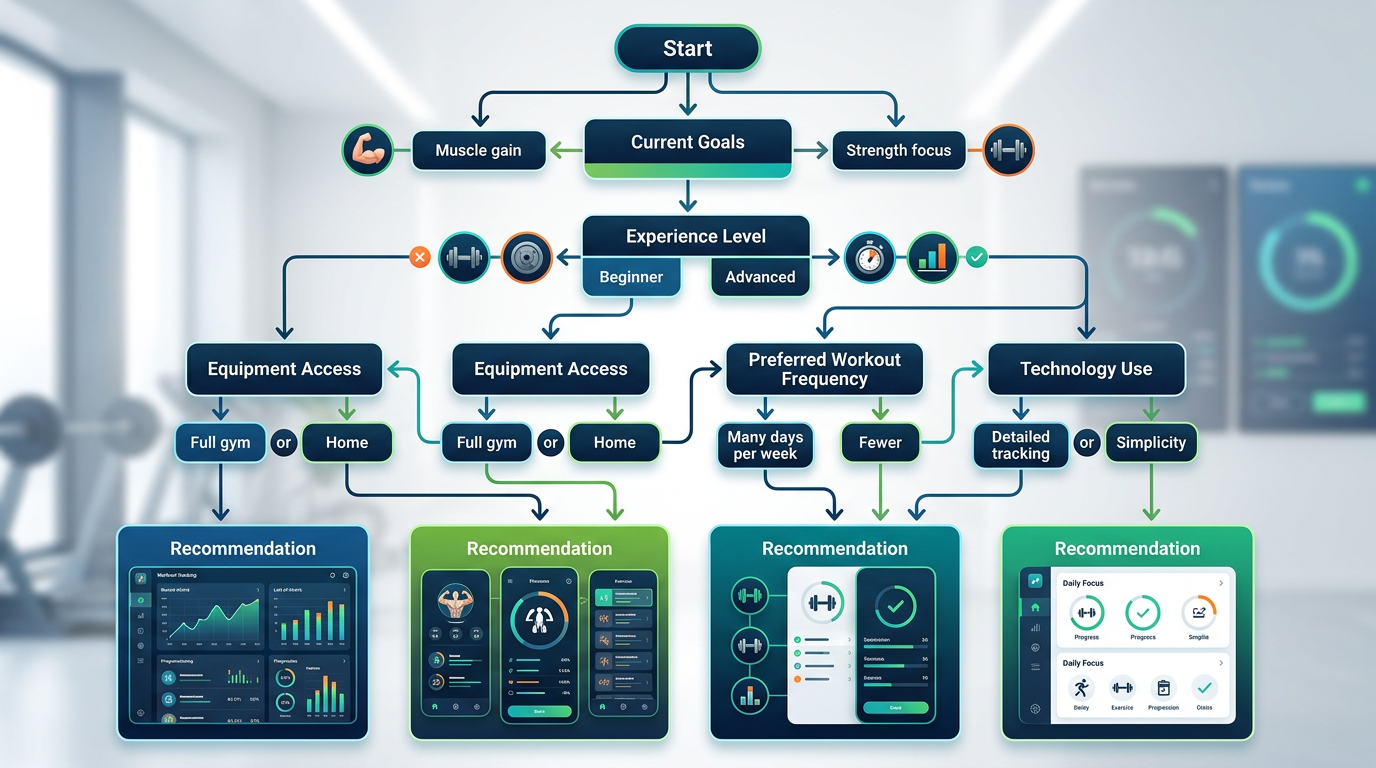
Decision tree flowchart helping lifters choose between Strong alternatives based on training style, program needs, and feature priorities
Switching from Strong: What to Expect
Moving to a new workout tracker takes adjustment. Most apps import Strong data, but the process varies.
Data Import and Migration
Strong exports workout data as CSV files. Hevy, GymTrack, and StrengthLog all support importing this data, though exercise name matching may require manual review. Expect to spend 15-30 minutes cleaning up imported data to ensure exercises map correctly.
Boostcamp does not import historical data since it focuses on starting new programs. If you want your complete training history in the new app, choose Hevy, GymTrack, or StrengthLog.
Learning Curve and Interface Adjustment
Hevy feels most similar to Strong with minimal learning curve. GymTrack requires learning gesture controls and smart defaults but becomes faster after 2-3 workouts. StrengthLog has more features, so the interface is more complex. Boostcamp is straightforward if you are following a program.
Give any new app three full workouts before judging. The first session always feels slower as you learn the interface.
Cost Comparison Over Time
Strong costs $30 annually. Over three years, that is $90. Boostcamp and GymTrack are free, saving you $90. Hevy and StrengthLog cost $120 annually for premium, totaling $360 over three years if you need premium features.
Calculate whether premium features justify the cost. If you only need logging and basic progress tracking, free alternatives match or exceed Strong's paid features.
Advanced Features in Modern Workout Trackers
The newest strong app alternatives include features that did not exist when Strong launched. These tools change how you approach training.
AI Coaching Based on Your History
GymTrack's AI coach reads your entire training history to provide personalized advice. It can identify when you typically need deloads, which exercises correlate with main lift progress, and what rep ranges you respond to best. This is different from generic AI that gives the same advice to everyone.
The AI analyzes patterns across months of data. If your squat always stalls after six weeks of high frequency, it will flag this and suggest adjustments. If your bench responds better to higher volume, it will recommend programming changes.
Automatic Periodization and Deload Detection
StrengthLog and some Boostcamp programs include automatic deload scheduling based on program phase. GymTrack's AI can suggest deloads based on performance drops or accumulated fatigue indicators.
This removes guesswork from when to back off. Instead of pushing through fatigue or randomly taking deloads, the app uses your data to time them properly.
Real-Time 1RM Projection and PR Detection
GymTrack projects your 1RM after every set using your actual performance. Hit a set of 225 for 8 reps at RPE 8, and it calculates your estimated max immediately. This lets you track strength progress without testing maxes, reducing fatigue and injury risk.
Automatic PR detection flags when you hit rep PRs, weight PRs, or volume PRs without you tracking manually. You know immediately when you have beaten a previous best at any rep range.
Common Mistakes When Switching Workout Apps
Lifters make predictable errors when trying new apps. Avoid these to make the transition smooth.
Switching Too Often
Trying a new app every month destroys data continuity. Pick one alternative, commit to it for at least 8-12 weeks, and evaluate after a full training block. You need time to learn the interface and accumulate enough data for analytics to be useful.
App hopping also fragments your training history across platforms, making long-term progress tracking impossible.
Ignoring Data Import
Starting fresh in a new app loses years of training data. Always import your Strong history when switching. This gives the new app context for PRs, baselines for analytics, and complete exercise history.
Even if import is not perfect, having 80 percent of your data is better than starting from zero.
Choosing Based on Features You Will Not Use
Do not pick an app because it has 50 features if you will only use five. Focus on what you actually need: logging speed, program support, or analytics depth. Extra features add interface complexity without value if you ignore them.
Be honest about your training style. If you never follow structured programs, do not choose an app because it has great program features. If you lift alone, do not prioritize social features.
The Future of Workout Tracking Apps
Workout trackers continue evolving. Understanding trends helps you choose apps that will improve rather than stagnate.
AI and Machine Learning Integration
More apps will add AI coaching trained on user data. The best implementations will provide truly personalized advice based on your specific response to training variables. Generic AI that gives the same advice to everyone will become obsolete.
Expect AI to handle program adjustments, exercise selection, and periodization planning based on your goals and recovery capacity. The apps that implement this well will separate from basic logging tools.
Wearable Integration and Recovery Metrics
Integration with wearables like Whoop, Oura, and Apple Watch will improve. Apps will use HRV, sleep quality, and readiness scores to adjust training recommendations automatically. If your recovery metrics are low, the app might suggest reducing volume or intensity for that session.
This bridges the gap between training load and recovery capacity, helping prevent overtraining and optimize adaptation.
Video Form Analysis
Some apps are testing AI-powered form analysis through your phone camera. Record a set, and the app flags form breakdowns or suggests technique improvements. This technology is early but improving rapidly.
For lifters without coaches, this could provide valuable feedback on movement quality and injury risk factors.
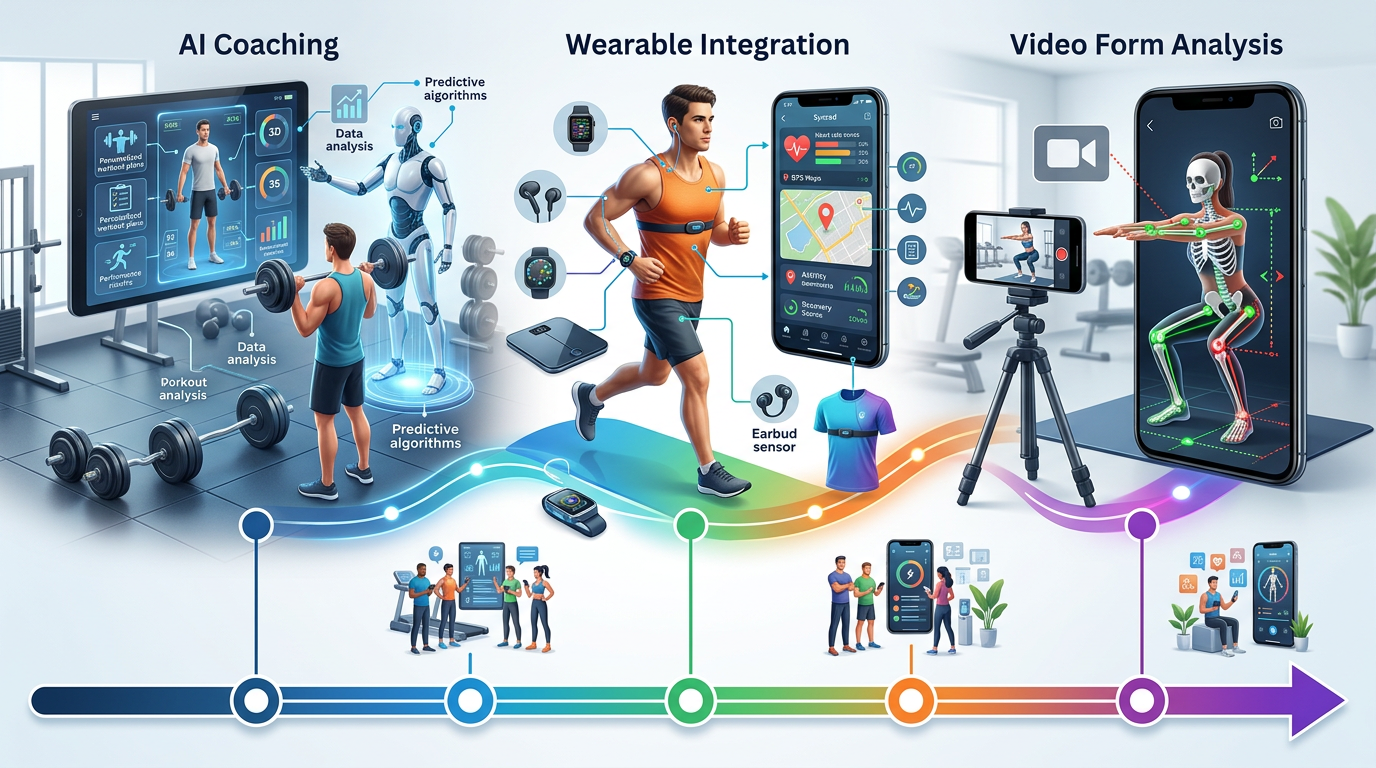
Infographic showing emerging workout app features including AI coaching, wearable integration, and video form analysis with timeline for mainstream adoption
Frequently Asked Questions
What is the best free alternative to Strong app?
Boostcamp and GymTrack are the best free alternatives to Strong. Boostcamp offers over 50 structured programs from respected coaches with automatic percentage calculations. GymTrack provides fast logging, automatic PR detection, projected 1RM, and AI coaching without any cost or feature limits.
Can I import my Strong workout history to other apps?
Yes, most strong app alternatives support importing Strong data. Export your workouts as CSV from Strong, then import into Hevy, GymTrack, or StrengthLog. Exercise name matching may require manual review, taking 15-30 minutes to ensure accurate mapping of your complete history.
Which workout tracker is fastest for logging sets?
GymTrack is the fastest workout tracker with sub-3-second set logging using smart defaults and gesture controls. Hevy and Strong require 3-4 seconds per set with standard tap inputs. StrengthLog takes slightly longer due to more detailed input options for comprehensive tracking.
Do any free apps offer better features than Strong premium?
Yes, several free apps exceed Strong premium features. GymTrack offers automatic PR detection, 1RM projection, and AI coaching at no cost. Boostcamp provides 50 plus structured programs with periodization for free. Both deliver more functionality than Strong's paid tier without subscription fees.
Which Strong alternative is best for powerlifting?
GymTrack and StrengthLog are best for powerlifting. GymTrack automatically projects 1RM, detects PRs across all rep ranges, and tracks RPE per set. StrengthLog offers powerlifting-specific programs with proper periodization and detailed strength analytics. Both handle percentage-based programming effectively.
How long does it take to learn a new workout tracking app?
Most lifters adapt to a new workout tracker within 2-3 training sessions. Hevy feels most similar to Strong with minimal learning curve. GymTrack requires learning gesture controls but becomes faster after initial workouts. Give any app three full sessions before evaluating its fit for your training.
What features should I prioritize in a workout tracker?
Prioritize logging speed, program support matching your training style, and analytics depth you will actually use. If you follow structured programs, choose apps with automatic percentage calculations and per-set targets. For general strength training, fast logging and automatic PR detection matter most.
Conclusion
Strong served its purpose as a simple workout tracker, but the best strong app alternatives now offer more features, faster logging, and better analytics at lower cost. Hevy adds social features while maintaining simplicity. Boostcamp provides free structured programs. GymTrack delivers the fastest logging with AI coaching. StrengthLog offers science-based training with deep analytics.
Your choice depends on training style and priorities. Program-focused lifters benefit from Boostcamp or StrengthLog. Speed matters most, try GymTrack. Want social features, choose Hevy. Most alternatives offer free tiers that exceed Strong's paid features, making switching a low-risk decision.
Import your Strong data, test your top two choices for three workouts each, and pick the one that fits your training flow best.
Log your next session in GymTrack
Fast set logging, automatic PRs, programs with per-set targets and an AI coach that reads your history. Free on iPhone and Android.
Get the app