 GymTrack
Best Workout Planner Apps: Top Picks for Lifters
November 3, 2026 · 25 min read
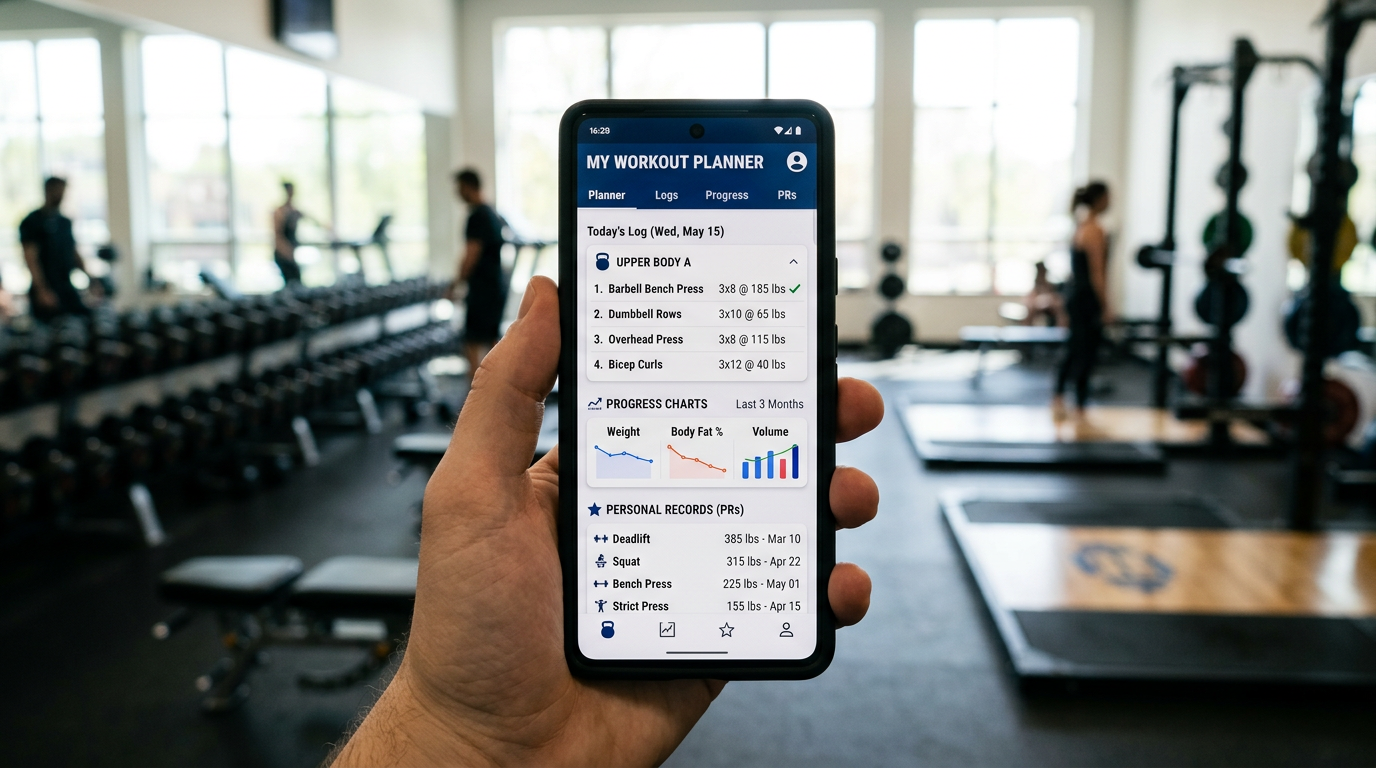
Best Workout Planner Apps: Top Picks for Lifters
The best workout planner apps for lifters include GymTrack for fast logging with AI coaching, Hevy for social features, Strong for simplicity, Boostcamp for free programs, and Fitbod for AI-generated workouts. These apps track sets, reps, weight, and automatically detect PRs to help serious lifters follow structured programs.
You need a workout planner app that keeps up with your training. Not something that makes you tap through five screens to log a set of squats.
The best workout planner apps let you record your lifts in seconds, track progressive overload, and follow structured programs without getting in your way. They automatically detect PRs, calculate projected 1RMs, and give you the data you need to make training decisions.
This guide covers the top workout tracking apps for people who lift 3-6 days a week. We tested each app by logging actual training sessions, comparing how fast you can record sets, and evaluating features that matter for strength training: program templates, automatic progression, exercise history, and analytics.
You'll see what each app does best, where it falls short, and which one matches your training style.
Key Takeaways
- GymTrack offers the fastest set logging with per-set targets, automatic PR detection, and AI coaching based on your training history
- Hevy provides strong social features and workout sharing but limits saved routines in the free version
- Strong excels at simplicity with clean interface and reliable tracking, though it lacks built-in programs
- Boostcamp gives free access to popular programs like nSuns and GZCL but doesn't include AI coaching
- Most serious lifters need automatic 1RM calculation, exercise history graphs, and program progression features
Quick Comparison: Top Workout Planner Apps
App
Best For
Free Version
Key Feature
Platform
GymTrack
Serious lifters
Full featured
AI coaching + fast logging
iOS, Android
Hevy
Social lifters
Limited routines
Workout sharing
iOS, Android
Strong
Simplicity seekers
Basic tracking
Clean interface
iOS, Android
Boostcamp
Program followers
Full programs
Free program library
iOS, Android
Fitbod
AI workouts
3 workouts
Generated routines
iOS, Android
JEFIT
Exercise database
Ad-supported
1300+ exercises
iOS, Android
Caliber
Coaching included
Trial only
Human coach
iOS, Android
Alpha Progression
RPE tracking
Limited
Auto progression
iOS, Android
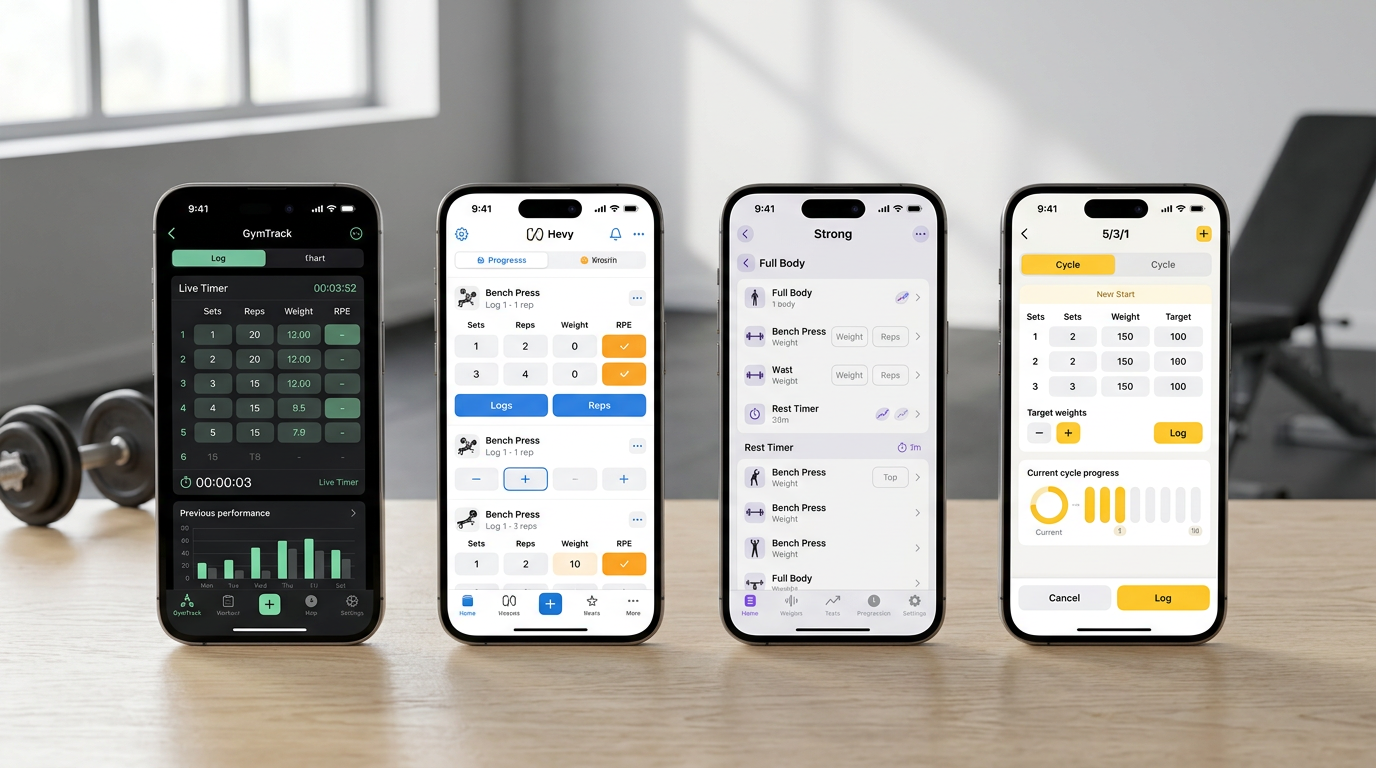
Comparison chart showing GymTrack, Hevy, Strong, and Boostcamp app interfaces side by side on mobile screens with workout logging screens visible
1. GymTrack
GymTrack is built for lifters who want fast logging, structured programs with per-set targets, and AI coaching that reads their entire training history. You can log sets in under 3 seconds by tapping weight and reps, then swiping to the next set.
The app automatically detects PRs across all rep ranges and calculates projected 1RMs using the Epley formula. When you open an exercise, you see your previous best sets right there, so you know what to beat.
Programs include per-set targets showing exact weight, reps, and RPE for each working set. The AI coach analyzes your training history to answer questions about your progress, weak points, and when to deload. It reads your actual logged data, not generic advice.
The free version includes unlimited workouts, all program features, automatic PR tracking, and AI coaching. No artificial limits on saved routines or exercise history.
Pros
- Fastest set logging interface tested, under 3 seconds per set
- AI coach trained on your personal training history
- Per-set targets for every exercise in programs
- Automatic PR detection across all rep ranges
- Completely free with no feature restrictions
Cons
- Smaller program library than Boostcamp
- No social features or workout sharing
- Newer app with smaller user community
2. Hevy
Hevy focuses on social features and workout sharing. You can follow other lifters, share your sessions, and browse community workouts. The interface is clean and the logging flow works well once you build your routine templates.
The app tracks your volume over time and shows exercise history with decent graphs. You get automatic rest timers and plate calculator. The exercise database is comprehensive with video demonstrations.
The free version limits you to 3 saved routines and restricts historical statistics to recent months. To access unlimited routines and full history, you need Hevy Pro at $72 per year.
Best for lifters who want social accountability and don't mind paying for advanced features. The community aspect helps some people stay consistent.
Pros
- Strong social features with workout sharing
- Clean interface with good exercise videos
- Active community for motivation
- Reliable tracking and rest timers
Cons
- Free version limits saved routines to 3
- Historical data restricted without Pro
- No built-in programs or AI coaching
- Slower logging than GymTrack
3. Strong
Strong delivers straightforward workout tracking without extra features. The app does one thing well: logging sets, reps, and weight quickly. The interface is minimal and the tracking is reliable.
You build your own routines and the app remembers your previous weights for each exercise. It shows your personal records and tracks total volume. The plate calculator helps you load barbells correctly.
Strong doesn't include built-in programs or coaching. You need to design your own training or follow a program from elsewhere and manually input the workouts. The free version includes basic tracking, while Strong Pro adds features like rest timer customization and cloud backup.
Best for lifters who already know what program they want to follow and just need reliable tracking without social features or AI coaching.
Pros
- Simple, distraction-free interface
- Reliable tracking that just works
- Good for custom programming
- Long track record and stable app
Cons
- No built-in programs or templates
- No AI coaching or smart features
- Limited analytics compared to competitors
- Manual routine setup required

Screenshot of Strong app exercise history screen showing squat progress graph with weight and volume trends over 12 weeks
4. Boostcamp
Boostcamp provides free access to popular strength programs including nSuns, GZCL, 5/3/1 variations, and programs from respected coaches. The app guides you through each workout with the prescribed sets, reps, and percentages.
Each program includes the original programming logic, so percentages adjust based on your training maxes. The interface shows what to lift each session and tracks your progress through the program phases.
The program library is the main draw. You get proven templates without paying for coaching or designing your own. The tracking features work well but aren't as fast as GymTrack. No AI coaching or advanced analytics.
Best for lifters who want to follow established programs like nSuns 5-day or GZCL without paying for program access. The free model makes quality programming accessible.
Pros
- Free access to popular programs like nSuns and GZCL
- Programs include proper progression logic
- Good selection of beginner to advanced templates
- Active program updates from coaches
Cons
- No AI coaching features
- Slower logging interface than GymTrack
- Limited customization of programs
- Analytics less detailed than competitors
5. Fitbod
Fitbod generates workouts using AI based on your available equipment, target muscles, and recovery status. The app tracks muscle fatigue and suggests exercises to balance your training across muscle groups.
Each workout adapts to your performance and the app automatically adjusts volume and intensity. The exercise recommendations change based on what you've trained recently. Good for people who don't want to plan their own sessions.
The AI generates workouts rather than following structured programs like 5/3/1 or Texas Method. This works for general fitness but serious strength programs require specific progression schemes that Fitbod doesn't follow.
The free version limits you to 3 workouts total. Full access costs $79.99 per year or $12.99 monthly. Best for lifters who want automated workout generation rather than following a specific strength program.
Pros
- AI generates workouts automatically
- Tracks muscle recovery and balances volume
- Good exercise variety and demonstrations
- Adapts to available equipment
Cons
- Doesn't follow structured strength programs
- Free version extremely limited (3 workouts)
- Generated workouts lack periodization
- Expensive compared to alternatives
6. JEFIT
JEFIT offers a massive exercise database with over 1300 movements and detailed instructions. The app includes workout templates, progress tracking, and social features. It's been around since 2010 and has a large user base.
You can browse community routines or build your own from the extensive exercise library. The tracking includes volume, tonnage, and body measurements. Rest timers and workout reminders help with consistency.
The free version shows ads and limits some features. JEFIT Elite removes ads and adds advanced analytics for $69.99 annually. The interface feels dated compared to newer apps and logging takes more taps than GymTrack or Strong.
Best for lifters who want access to a huge exercise database and don't mind an older interface style. The community features and long history appeal to some users.
Pros
- Massive exercise database with 1300+ movements
- Large community and shared routines
- Body measurement tracking included
- Long track record since 2010
Cons
- Dated interface compared to modern apps
- Slower logging workflow
- Ads in free version
- Less intuitive than newer alternatives

Side-by-side comparison of workout logging screens in JEFIT and GymTrack showing the number of taps required to log a set of bench press
7. Caliber
Caliber pairs you with a human coach who designs your program and adjusts it based on your feedback. The app includes video form checks where your coach reviews your lifting technique and provides corrections.
Your coach creates periodized programs tailored to your goals, equipment, and schedule. You communicate through the app and get responses within 24 hours. The programming adapts based on your progress and any issues you report.
The service costs $99 per month, significantly more than app-only options. The free trial lets you test the coaching for 7 days. Best for lifters who want personalized coaching and can afford the monthly cost.
The human coaching element provides accountability and expertise that AI can't fully replicate. But the price puts it in a different category than the other apps on this list.
Pros
- Real human coach designs your program
- Video form checks with feedback
- Personalized programming that adapts
- High accountability factor
Cons
- Expensive at $99 per month
- No free version beyond trial
- Coach response time up to 24 hours
- Overkill if you just need tracking
8. Alpha Progression
Alpha Progression focuses on automatic progression and RPE tracking. The app suggests weight increases based on your performance and includes built-in deload protocols. It tracks RPE (Rate of Perceived Exertion) for each set to monitor fatigue.
The progression algorithm adjusts your training weights automatically using your logged RPE and completed reps. When you consistently hit your targets, the app increases the load. If you're struggling, it recommends backing off.
The free version limits workout history and some progression features. Alpha Progression Pro costs $49.99 annually. The app works well for linear progression but doesn't include the program variety of Boostcamp or the AI coaching of GymTrack.
Best for intermediate lifters who want automated progression logic and detailed RPE tracking without manually calculating their next session's loads.
Pros
- Automatic progression based on performance
- Detailed RPE tracking per set
- Built-in deload recommendations
- Good for linear progression phases
Cons
- Free version heavily restricted
- Limited program templates
- Progression logic less flexible than custom programming
- No AI coaching features
9. RepCount
RepCount uses your phone's camera and AI to automatically count reps during your sets. You prop your phone up, start the set, and the app counts your reps in real-time. It logs the workout without manual input.
The computer vision works reasonably well for exercises where your body moves in a consistent pattern like squats, push-ups, or curls. It struggles with exercises that have less obvious movement patterns or when the camera angle is poor.
The automatic counting sounds appealing but in practice most lifters find it faster to just tap the reps after the set. Setting up your phone for the right camera angle adds friction. The app also lacks advanced features like program templates or AI coaching.
Best for people who really want automatic rep counting and are willing to deal with camera setup. Most serious lifters will find manual logging faster and more reliable.
Pros
- Automatic rep counting via camera
- Hands-free logging during sets
- Novel approach to tracking
- Works well for basic movements
Cons
- Camera setup adds time and friction
- Inconsistent accuracy across exercises
- Lacks program features and coaching
- Manual logging often faster in practice
10. FitNotes
FitNotes is a no-frills Android app that tracks workouts with a simple interface. It's completely free with no ads, subscriptions, or feature restrictions. You log exercises, sets, reps, and weight with minimal tapping.
The app shows your exercise history, calculates estimated 1RM, and tracks body measurements. You can export your data as CSV or backup to Google Drive. The developer maintains it as a passion project.
FitNotes doesn't include programs, social features, or AI coaching. It's pure tracking with a functional design. The interface looks dated but works reliably. Only available on Android.
Best for Android users who want free, ad-free tracking without any extra features. If you just need to log your lifts and see your history, FitNotes delivers without trying to upsell you.
Pros
- Completely free with no ads or subscriptions
- Simple, functional interface
- Reliable tracking and data export
- No account required
Cons
- Android only, no iOS version
- No programs or coaching features
- Dated interface design
- Limited analytics compared to modern apps

Infographic showing the key features comparison between GymTrack, Strong, and FitNotes including logging speed, program support, AI features, and pricing
What Makes a Good Workout Planner App for Lifters
The best workout planner apps share specific features that matter for strength training. Not all tracking apps work well for people who follow programs and care about progressive overload.
Fast Set Logging
You should be able to log a set in under 5 seconds. Apps that require multiple screen taps or navigation slow down your workout and kill momentum between sets. GymTrack logs sets in 3 seconds. Hevy and Strong take 5-7 seconds. JEFIT takes 10+ seconds with its older interface.
The difference matters when you're logging 15-25 sets per session. An extra 5 seconds per set adds 2-3 minutes to your workout over time.
Automatic PR Detection
The app should automatically detect personal records across all rep ranges without manual checking. When you squat 225 for 8 reps, the app should know if that's a PR for the 8-rep range and show it immediately.
GymTrack, Strong, and Hevy all include automatic PR detection. Boostcamp shows PRs but less prominently. Apps without this feature make you manually track your bests, which most people won't do consistently.
Exercise History
You need to see your previous performance for each exercise before starting your working sets. The app should show your last session's weights and reps, plus your all-time bests for that movement.
Good apps display this information automatically when you open an exercise. You shouldn't need to navigate to a separate history screen or remember what you lifted last week.
Program Support
For lifters following structured programs, the app needs to handle per-set targets and progression schemes. You should see the prescribed weight, reps, and RPE for each set based on your training maxes.
GymTrack and Boostcamp excel here with full program support. Strong requires manual input of your program structure. Fitbod generates workouts but doesn't follow established strength programs.
1RM Calculation
The app should calculate and track your estimated 1RM for major lifts based on your logged sets. Most use the Epley formula: 1RM = weight × (1 + reps/30). This helps you set training maxes and track strength progress over time.
All the major apps include this feature. The implementation varies in how prominently it's displayed and whether it tracks 1RM history over time.
Free vs Paid: What You Actually Need
Most workout planner apps use a freemium model with a limited free version and paid tier. Understanding what features matter helps you decide if you need to pay.
Essential Features (Should Be Free)
Core tracking functionality should work in the free version. This includes logging unlimited workouts, tracking exercise history, and seeing your PRs. If an app restricts basic tracking, consider alternatives.
GymTrack and FitNotes offer full features free. Strong and Hevy limit some features but include core tracking. Fitbod's free version is too restricted (3 workouts total) to be useful.
Premium Features Worth Paying For
AI coaching that reads your training history provides value if you want personalized guidance without hiring a coach. GymTrack includes this free. Caliber charges $99 monthly for human coaching.
Advanced analytics like volume tracking across muscle groups, periodization tools, and detailed progress graphs help intermediate and advanced lifters. These features justify paying $40-70 annually if you use them.
Cloud backup and sync across devices matter if you switch phones or want to access your data on multiple devices. Most paid tiers include this.
Premium Features Not Worth Paying For
Social features and workout sharing rarely justify subscription costs. If you want social accountability, free options exist. Don't pay primarily for the ability to share workouts with friends.
Exercise video libraries sound useful but free YouTube resources provide better instruction. Paying for an app's video database adds little value.
Removing ads is fine if you like the app, but consider whether free alternatives without ads (like GymTrack or FitNotes) meet your needs first.
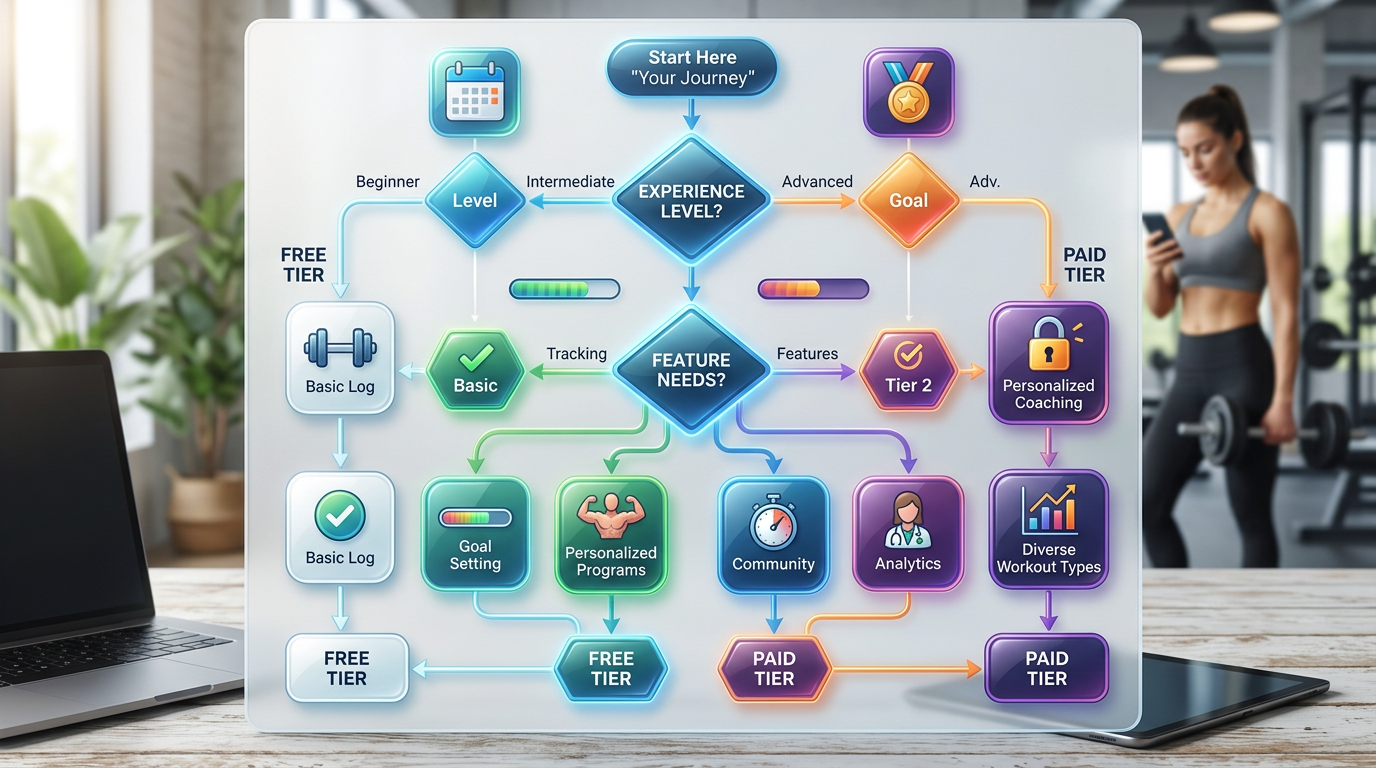
Flowchart diagram helping users decide between free and paid workout app tiers based on training experience and feature needs
How to Choose the Right App for Your Training
Your training style and experience level determine which workout planner app works best. A beginner following Starting Strength needs different features than an intermediate lifter running a customized program.
For Beginners (0-1 Year Training)
Start with an app that includes proven beginner programs and guides you through each workout. Boostcamp works well because it provides free access to programs like GZCLP and 5/3/1 for Beginners with built-in progression.
You don't need advanced analytics or AI coaching yet. Focus on learning the lifts and following a program consistently. The app should make it obvious what to do each session.
GymTrack also works well for beginners because the AI coach can answer questions about your progress and the fast logging keeps workouts moving.
For Intermediate Lifters (1-3 Years Training)
At this stage you benefit from detailed progress tracking, automatic PR detection, and either structured programs or the flexibility to program yourself. You're making slower progress and need to track volume and intensity carefully.
GymTrack provides the best combination of fast logging, program support, and AI coaching for intermediate lifters. The per-set targets help you follow percentage-based programs accurately.
Strong works if you program yourself and want simple, reliable tracking. Hevy adds social features if that motivates you.
For Advanced Lifters (3+ Years Training)
Advanced lifters need detailed analytics, flexible programming, and the ability to track training variables like RPE, bar speed, or fatigue. You're probably running customized programming and need an app that doesn't limit your options.
GymTrack's AI coaching becomes more valuable as your training history grows. The AI can identify patterns in your progress and suggest adjustments based on your specific response to training.
Alpha Progression works well if you want automatic progression logic with detailed RPE tracking. Strong remains a solid choice for simple tracking without restrictions.
For Program Followers
If you follow established programs like 5/3/1, nSuns, or GZCL variants, you need an app with built-in program support or easy program input. Boostcamp offers free access to many popular programs.
GymTrack lets you follow programs with per-set targets showing the exact prescribed work. You can also build custom programs with your own progression schemes.
Strong requires manual program setup but works once you've built your templates. The lack of built-in programs means more upfront work.
For Custom Programmers
Lifters who design their own training need flexibility and detailed tracking without the app forcing a specific structure. Strong and GymTrack both allow custom programming.
GymTrack's AI coach helps custom programmers by analyzing their training data and providing feedback on their programming decisions. Strong keeps it simple with pure tracking.
Avoid apps like Fitbod that generate workouts automatically if you want full control over your programming.
Which Workout Planner App Is Best For You?
Choose GymTrack if you want the fastest logging, AI coaching based on your training history, and full program support without paying. The app works for beginners through advanced lifters and includes automatic PR detection across all rep ranges. The AI coach provides personalized guidance as your training history builds. Best for serious lifters who train 3-6 days weekly and want data-driven feedback.
Choose Hevy if social features and workout sharing motivate you. The community aspect helps with accountability and you can browse other lifters' routines. The free version limits saved routines to 3, so you'll likely need Hevy Pro at $72 annually. Best for lifters who train better with social accountability.
Choose Strong if you want simple, reliable tracking without extra features. The app does one thing well: logging your lifts. You'll need to design or input your own programs. Best for lifters who already know their program and just need clean tracking.
Choose Boostcamp if you want free access to popular programs like nSuns, GZCL, or 5/3/1 variations. The program library is the main draw. Logging is slower than GymTrack but the free program access provides value. Best for lifters following established templates.
Choose Fitbod if you want AI-generated workouts and don't care about following specific strength programs. The app creates variety and balances muscle groups automatically. The free version is too limited (3 workouts), so plan on paying $79.99 annually. Best for general fitness rather than serious strength training.
Choose FitNotes if you're on Android and want completely free tracking with no ads or subscriptions. The interface is dated but functional. No programs or coaching, just pure tracking. Best for Android users who want free, no-frills logging.
For most serious lifters, GymTrack provides the best combination of fast logging, program support, automatic PR tracking, and AI coaching in a fully-featured free app. Check out our guide to best free workout tracker apps for more options.
Frequently Asked Questions
What is the best free workout planner app for lifters?
GymTrack is the best free workout planner app because it includes unlimited workouts, AI coaching, automatic PR detection, and program support without restrictions. FitNotes offers simple free tracking on Android. Boostcamp provides free access to popular programs but lacks AI coaching features.
How do workout planner apps track progressive overload?
Workout planner apps track progressive overload by logging your sets, reps, and weight each session, then calculating total volume and detecting PRs. They show your previous performance before each exercise so you know what to beat. Advanced apps calculate estimated 1RM and track strength trends over time.
Do I need to pay for a workout tracking app?
Most lifters don't need to pay for workout tracking. GymTrack and FitNotes offer full features free. Strong and Hevy provide core tracking free but limit some features. Pay only if you specifically need premium features like advanced analytics or human coaching that justify the cost.
Which workout app has the best built-in programs?
Boostcamp has the largest library of free built-in programs including nSuns, GZCL, and multiple 5/3/1 variations from respected coaches. GymTrack includes programs with per-set targets and AI coaching. Strong and Hevy require manual program input or custom routine building without built-in templates.
Can workout planner apps replace a personal trainer?
Workout planner apps can replace programming and progress tracking functions but not form coaching or real-time feedback. GymTrack's AI coach provides guidance based on your training data. Caliber includes human coaches for $99 monthly. For technique instruction, you still need in-person coaching or video analysis.
How long does it take to log a workout with an app?
Logging takes 30-90 seconds per workout with fast apps. GymTrack logs sets in under 3 seconds each. Strong and Hevy take 5-7 seconds per set. Older apps like JEFIT take 10+ seconds per set. For a 20-set workout, this means 1-3 minutes total logging time with modern apps.
What features matter most in a workout planner app?
The most important features are fast set logging, automatic PR detection, exercise history before each set, and program support with per-set targets. Serious lifters also benefit from 1RM tracking, volume analytics, and AI coaching. Social features and exercise videos are nice but not essential for progress.
Conclusion
The best workout planner apps help you log workouts faster, track progressive overload accurately, and follow structured programs without friction. GymTrack delivers the fastest logging with AI coaching and full program support free. Hevy adds social features for accountability. Strong provides simple, reliable tracking. Boostcamp gives free access to proven programs.
Choose based on what matters most: logging speed, program library, AI coaching, or social features. Most serious lifters benefit from automatic PR detection, exercise history, and 1RM tracking regardless of which app they pick.
The right app makes tracking effortless so you can focus on the actual training.
Log your next session in GymTrack
Fast set logging, automatic PRs, programs with per-set targets and an AI coach that reads your history. Free on iPhone and Android.
Get the app